The Named Stars: A Guide to the Stars That Survived
Betelgeuse, Aldebaran, Vega, Algol, Deneb, Rigel, Altair, Fomalhaut, named stars, the names rattle off the tongue as we watch the night sky. To an English speaker, they don’t quite sound as if they have a Latin derivative, and they don’t. These names come from Arabic star catalogs written during the golden age of Islam, from the 8th to the 13th centuries CE. Islamic scholars were themselves working with constellation figures recorded by Ptolemy. European astronomers transliterated Arabic words into Latin during the 11th to 13th centuries. They persist to this day, and using them, the IAU has officially standardized more than 600 star names. Only a small fraction of naked-eye stars have proper names. Only roughly 300 stars have historically derived names out of approximately 9,000 visible to the naked eye.
Table of Contents
The named stars: how they got the names we still use
Beneath star names lie four distinct naming traditions, each with its own origin and logic. Arabic traditions gave the majority of names. Greek and Latin cultures each named some, and in the last decade, the International Astronomical Union has begun formally adding names from cultures whose star records were never included in the European catalogs.
The Arabic inheritance
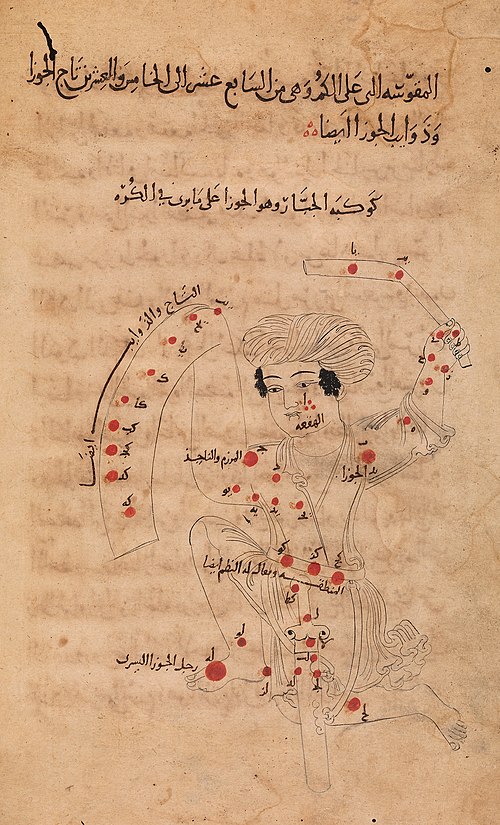
Orion, from the Book of the Fixed Stars (1009)
Abd al-Rahman al-Sufi, Bodleian Libraries MS. Marsh 144 / Wikimedia Commons · CC BY 4.0
When we look at individual star names, Arabic star names predominate. Because their positions in a constellation often name them, their names reference their physical descriptions. Al-Sufi, a Persian astronomer (903–986 CE), wrote a book called the Book of the Fixed Stars in 964 CE, describing the 48 constellations and the stars within them, including their relationships to other constellation figures. It is a landmark catalog written in Arabic within the Islamic scholarly tradition. Among the named stars in our opening list: Aldebaran comes from the Arabic al-dabarān, “the follower,” so called because it follows the Pleiades across the sky. Betelgeuse came to English tradition from the Arabic name yad al-jawzā’, the hand of al-Jawzā’. This is the figure that Arabic astronomers applied to the stars of Gemini. That same name was later applied to Orion after Greek traditions reached Arabia. Rigel comes from rijl al-jawzā’, “the left foot of the giant.” The Book of the Fixed Stars was partially translated into English in 2010, more than 1,000 years after al-Sufi’s death, though it had been translated into French in 1874.
What set al-Sufi’s catalog apart for early astronomy times was that it did not merely copy Ptolemy’s positions. He observed the sky, refined the star magnitudes recorded in the Almagest, and added Arabic asterisms alongside the inherited Greek figures. He is also the first known astronomer to describe what we now call the Andromeda Galaxy, which he wrote about as “a small cloud.” His catalog served as the reference for Islamic astronomy for hundreds of years.
The other names from the opening list follow the same lines. Vega is from al-nasr al-wāqi’, the falling eagle, since Arabic astronomers saw Lyra as a swooping bird rather than a lyre. Altair is its pair: al-nasr al-ṭā’ir, the flying eagle, soaring rather than diving. Deneb comes from dhanab al-dajājah, the tail of the hen, the Cygnus figure read as a hen in the Arabic tradition. Fomalhaut is fam al-ḥūt, the mouth of the fish, and Mizar, the middle star of the Big Dipper’s handle, is from mi’zar, the wrapper or girdle. Algol, the demon star of Perseus, is ra’s al-ghūl, the head of the ghoul, sitting where the Greek tradition placed Medusa’s severed head. Algol is also the first known eclipsing binary, dimming by about a magnitude every 2.87 days, which may well be one if the original reasons the medieval name reaches for something monstrous.
Arabic names entered Europe through the translation schools of medieval Spain, most notably Toledo in the 12th and 13th centuries, where Arabic, Hebrew, and Latin scholars worked side by side, translating Arabic scientific texts into Latin. The translators kept the Arabic star names rather than inventing new ones, but they often worked by ear and copied scripts they could not always parse cleanly. The errors hardened over generations of further copying, which is how a fair number of the names we use today carry the trace of a medieval Spanish scriptorium more than the original Arabic phrase.
The Greek layer

Claudius Ptolemy, Frontispiece Engraving (1596)
Theodor de Bry / Wikimedia Commons · Public domain
Greek star names are derived from both the Greek language and the works of Claudius Ptolemy (c. 100–170 CE). It would be difficult to overestimate his impact; his geocentric model of the universe held sway in European and Islamic astronomy from ancient times through the Copernican revolution of the 16th century and was not displaced in practice until the work of Kepler and Galileo in the 17th.
Sirius comes from the Greek word seirios, “heat” or “scintillation,” referring to its status as the brightest star in the night sky.
Arcturus comes from the Greek arktouros, “bear-watcher,” as it appears to follow Ursa Major across the sky.
Antares comes from anti-Arēs, “rival of Mars,” named for its red color rivaling that of Mars.
Procyon originates from prokyōn, “before the dog,” as it rises before Sirius, the dog star.
A smaller Latin trace

Astronomia, from the Margarita Philosophica (1503)
Gregor Reisch / Wikimedia Commons · Public domain
Though less prominent, Renaissance astronomers and atlas makers assigned Latin names to some stars. Regulus means “little king,” and the name is associated with Copernicus, who popularized it, though it has earlier medieval roots. Spica is named for “ear of grain,” held in the hand of the figure of Virgo. Finally, Polaris, the “pole star,” is Latin-derived, but the name is post-medieval; it has been near the celestial pole since around 500 CE and will remain so until roughly 2100 CE, when precession will carry it very slowly away. In astronomical terms, that is a recent tenure.
Cor Caroli, the alpha star of Canes Venatici, is later still and more deliberate, the Latin phrase for “Charles’s heart,” perhaps coined in the late 17th century to honor Charles I of England. The naming is closer to a memorial than a description, a rare case of a star carrying a political dedication rather than a physical or mythic one. Polaris itself will not hold its role much longer; the axis is already swinging past it.
The voices being added back
But Arabic, European, and Greek traditions were not the only cultures that named stars. Many other systems of nomenclature exist; they were not absorbed into the unstandardized naming system that modern astronomy inherited. In fact, before 2016, star names were not standardized; the same star might have several spellings or variant names in use simultaneously, a source of confusion across catalogs and atlases. To address this, the IAU Working Group on Star Names (WGSN) was established in 2016 and has since been formally adding and standardizing names. Not only are they creating a uniform database, but they are also adding star names from Chinese, Indigenous Australian, Polynesian, Inuit, and other traditions. The named-star record, in other words, is still being written.
The list is dynamic, with new stars being added. Tianyi, 7 Draconis, bears the name Celestial Great One in Taoism, which was formally adopted in 2017. Barnard’s Star, which moves faster across the sky than any other star known, is named for the American astronomer who first noticed that motion in 1916, a reminder that some “names” in the modern catalog are honorifics from within the discipline rather than inheritances from an older tradition. The IAU’s 2018 working list took in names from Indigenous Australian, Polynesian, Inuit, and other star-naming cultures whose records were oral or otherwise outside the European chain of catalogs.
Why are different traditions named different things
There is an overall pattern, and the star names begin to organize. The Arabic names tend to describe a star’s role inside a figure: the follower, the hand, the foot, the tail, the wing, the wrapper, the head. They read like labels on a diagram, which is essentially what they were. Arabic astronomers inherited the Greek constellation figures from Ptolemy and set about naming the parts. The Greek and Latin names, by contrast, tend to describe the star itself: its color, brightness, behavior, and mythic identity. Sirius is scorching. Antares rivals Mars. Regulus is a little king. The two approaches answer different questions about a point of light, and most of our modern names are a mix of the two, depending on which tradition got there first and which translation chain carried the word forward.
Letters and numbers, for the rest
Most stars do not have names; many are designated only by a Greek letter or a number.
The Greek letters come from Johann Bayer, a German astronomer who published Uranometria in 1603, the first star atlas to cover the entire celestial sphere. He assigned Greek letters (α, β, γ…) to stars within each constellation, ordered roughly by brightness, so α is usually the brightest and β the second brightest, though he was not always consistent. These designations coexist with proper names; Vega, for example, is both α Lyrae and Vega, both correct in different contexts.
Beyond that, most stars appear only in modern catalogs, such as the HD (Henry Draper catalog), HIP (Hipparcos catalog), and HYG, which together cover hundren of thousands of stars but still represent only a fraction of the estimated 100 to 400 billion stars in the Milky Way. A proper name is a rare distinction; most stars are numbers, and most are not even that.
What survives
In the end, what we call the stars comes from thousands of years of copying, mistranslation, and garbled transliteration; even the oldest records, those of earlier civilizations, came from them.
Some medieval names have nearly evaporated. Cor Leonis, “the heart of the lion,” was Regulus’s standard label in European astronomy for centuries before the shorter Latin name took over. Polaris itself was often called Cynosura, after a Greek epithet for the Little Bear, and Stella Polaris before settling into its current single-word form. The IAU freeze is the first time in the catalog’s history that the names have been held. Before that, looking up a star meant choosing between several spellings depending on which atlas you opened.