How Does an Astrolabe Work? The Sky’s First Computer
Before modern clocks, before calculators, before computers, and definitely before the internet, people used a flat brass disc called an astrolabe to tell time from a star’s position. Spin its dial, and it shows you star positions. Run it backward, align the disc to the sky overhead, and it tells the hour. It did this with no further calculations beyond the instrument. If you want to skip the history and try one out, we have a working astrolabe further along in this series.
What an astrolabe is
Physically, an astrolabe is a flat circular instrument, usually made of brass, ranging in size from palm to dinner plate. It is built from a few nested parts:
- The mater, Latin for mother, is the base disc with a raised rim that holds everything else.
- The plate, sometimes called the tympanum, sits inside the mater. It is engraved with the coordinates of the sky as seen from one specific latitude. Because a traveler changes latitude, an astrolabe typically came with several plates that could be swapped in and out.
- The rete is a pierced disc that rotates atop the plate. It carries pointers to the brightest stars and a ring representing the ecliptic, the Sun’s yearly path. The rete is a map of the heavens, and turning it simulates the sky’s daily rotation.
- The rule is a movable pointer on the front for reading off coordinates, and the alidade is a sighting bar on the back for measuring the altitude of the Sun or a star.
The back of the instrument was engraved with useful information: a calendar relating each day to the Sun’s position, scales for trigonometry, and scales for the geometry of shadows. A skilled operator could extract information from these few engraved surfaces.
The mathematics
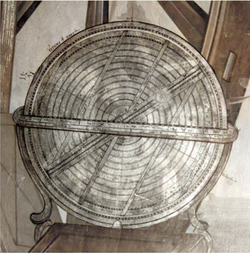
Detail of an astronomical instrument as painted by the Cretan icon painter Ieremias Palladas
Ieremias Palladas, CC BY-SA 4.0, via Wikimedia Commons
An astrolabe’s plate is a stereographic projection of the sky as seen from one latitude. It works in the same way flat star maps do, and faces the same challenges of mapping a sphere onto a flat surface. The projection is taken from one celestial pole onto the plane of the equator, turning a circle on the sphere of the sky into a circle on the flat plate. The horizon, the lines of equal altitude, and the daily circles the stars trace are set in the brass as arcs of circles. Circles are a curve an engraver can lay down precisely with a compass.
The rete is the same projection applied to the stars. Lay it over the plate, and you have the sky placed against the local horizon. Rotate it, and see the heavens in their arc. To calculate what is visible at a given moment, you align the rete with that time and read off which stars are above the horizon. To find when a star will rise, you turn the rete until that star touches the horizon, then read the time. To our ancestors, this must have been a groundbreaking way to navigate across land, calculate, and keep accurate time.
The refinement in the Islamic world
The basic concepts of the astrolabe predate Islam. In fact, the roots of its geometry date back to Greek astronomy, and the first recorded work on the astrolabe was written by Theon of Alexandria in the fourth century. However, the instrument, as the world came to know it, was the achievement of astronomers in the Islamic world from the eighth century onward, during the Golden Age of Islam.
Later sources credit the first Arabic astrolabe to al-Fazari in eighth-century Baghdad, though the attribution is traditional rather than firmly documented. What is documented is that the instrument developed quickly from there.
Al-Khwarizmi, the mathematician whose name gives us the word “algorithm,” wrote about its construction and use, while several undated Abbasid instruments survive from the ninth century or earlier. The earliest one bearing a maker’s name and date is the work of Nastulus, dated to 927 or 928, and in 984, al-Khujandi, working under Buyid patronage, made an astrolabe that survives today. Al-Sufi, the cataloguer of stars discussed earlier in this series, wrote a treatise describing a thousand distinct problems that could be solved with an astrolabe.
The astronomer al-Biruni, working around the year 1000, further expanded the astrolabe’s utility. He wrote extensively on the theory of the instrument and described how a train of gears could be added to make it show the changing positions of the Sun and Moon. That idea of gearing, set down centuries before the mechanical clock, survives in a working object: a geared astrolabe made by Muhammad ibn Abi Bakr in Isfahan around 1221, the oldest complete geared machine known. The instrument spread westward through Islamic Spain into Christian Europe by the eleventh century and remained in use until the eighteenth century.
What it could do

A brass planispheric astrolabe by Georg Hartmann, in the Yale collection
Ragesoss, CC BY-SA 3.0, via Wikimedia Commons
For astronomers, the astrolabe was a useful tool. It told the time, day or night, by the Sun or by a star, to within a few minutes. It also gave the latitude from the height of the pole star, predicted when stars would rise and set, and found the date from the Sun’s position. With the scales on the back, it solved trigonometry problems, and with the sighting bar, it could survey land. It was also the standard tool for casting horoscopes in the Islamic world and, later, in Europe.
For Muslims, it filled a religious need. A Muslim is required to face Mecca in prayer and to pray at five times fixed by the Sun’s position in the sky. Both are, underneath, problems in spherical astronomy, exactly the kind of problem the astrolabe was built to answer. Finding the direction of Mecca, the qibla, from an arbitrary city, and finding the times of the five daily prayers were daily religious necessities. This need drove much of astrolabe-making and the supporting mathematics across the Islamic world. The astrolabe that could tell a traveler the hour could also tell a city which way to turn and when, and that gave it a place in ordinary life that pure astronomy never would have.
The visual tradition
Islamic astrolabes were objects of beauty. The rete, in particular, was often worked into something resembling fine lacework, and its star pointers were shaped as flourishes of metal. The ecliptic ring remained a clean, off-center curve, and the pierced disc was both ornamental and functional, etched with calligraphy that carried the star names in Arabic script and numeration.
Change over time

Opening of the first book on the spherical astrolabe from the Libros del saber de astronomía compiled under Alfonso X
José Luis Filpo Cabana, CC BY 3.0, via Wikimedia Commons
We have preseved astrolabes look at and see how they evolved. The Nastulus astrolabe of 927 or 928, the earliest signed and dated example, is different than later instruments. It holds only one plate, without the possibility of adding more, the back of the instrument was simple, and the rete was plain.
The Verona astrolabe, identified only in 2024, is an eleventh-century Andalusian instrument carrying latitude plates for Córdoba and Toledo, later marked up in Hebrew and in a Western language by successive owners across centuries, a single object that passed through Muslim, Jewish, and Christian hands and recorded the journey on its own brass.
The geared astrolabe of 1221 from Isfahan marks the beginning of the line that leads to clockwork. The arrival of the instrument into European life is captured by Chaucer, who wrote a treatise on the astrolabe for his young son in 1391, in English, making it one of the first technical manuals in the language. Major collections at Oxford, Cambridge, and the Adler Planetarium in Chicago hold many more, a good number of them viewable online.