Al-Sufi Star Catalog: The Astronomer Who Wrote the Sky
Al-Sufi and the Arabic Star Tradition
After the fall of the Western Roman Empire (476 CE), most of Western Europe saw a gradual decline of its educational and economic infrastructure. Luckily, Greek scientific learning did not entirely vanish from Christendom. Though altered, the Eastern Roman (Byzantine) Empire continued for nearly another thousand years and retained many Greek texts in their original language. During this time period, scholarship was preserved largely in monasteries within the Church, where monks copied manuscripts by hand. They did, however, concentrate mostly on Latin literature and theology rather than Greek science and traditions.
Meanwhile, the Islamic world was flourishing. During the Golden Age of Islam, court astronomers expanded on Greek mathematics, philosophy, and astronomy, adding to the general body of knowledge. When European society entered the Renaissance, translated Arabic works were a major route by which Greek science returned. In astronomy, especially, Arabic translation and refinement are how many Greek concepts re-entered Europe, and most of the proper Western star names we use today descend from Arabic-to-Latin translations.
The clearest evidence of this transmission shows in our modern star chart. The Arabic names that European astronomy inherited, Aldebaran, Vega, Betelgeuse, Rigel, Algol, Altair, Deneb, Fomalhaut, most convey through a single book written in Persia in 964 CE: al-Sufi’s Book of the Fixed Stars. That same book gave the world its first written description of the Andromeda Galaxy, more than six centuries before European astronomers recorded it.
Table of Contents
Who was Al-Sufi?

Al-Sufi as “Azophi Arabus,” one of four astronomers in the corners of Dürer’s northern star map, 1515
Albrecht Dürer, CC BY-SA 4.0, via Wikimedia Commons
One of the most prominent Arabic astronomy works of this era was written by al-Sufi (Abd al-Rahman al-Sufi, 903–986 CE), who was born in Rey, near modern Tehran. As an adult, he worked in Persian courts, writing in Arabic and drawing on established Arabic scientific traditions. His most famous book is his star catalog, the Book of the Fixed Stars (964 CE), in which he systematically reviewed and reworked Ptolemy’s star catalog from the Almagest.
He corrected errors and revised Ptolemy’s magnitude estimates against his own observations. He also made the earliest known written record of the Andromeda Galaxy (M31), describing it as a “little cloud”; it is the earliest known written record of a galaxy beyond the Milky Way.
The name “al-Sufi” reflects his religious affiliation, and, as was typical of scholarly work of the time, he combined observational science with spiritual practice, as was typical of scholarly work of the time. He served the court of the Buyid emir Adud al-Dawla, an active patron of astronomy, who, as was typical of the royal class, supported the careful observational work that produced this catalog. Al-Sufi’s son and several of his students carried his methods forward, including, by tradition, the painter who illustrated the earliest surviving manuscript of the catalog.
The book
Al-Sufi’s book, Kitāb Ṣuwar al-kawākib al-thābita (Book of the Forms of the Fixed Stars), was completed in 964 CE. It consisted of 48 chapters, one for each Ptolemaic constellation. Each chapter described the constellation figure, gave the star list with positions and magnitudes, and included two illustrations: one showing the constellation as seen from Earth, and one mirror-reversed, as it would appear on a celestial globe viewed from outside.

Sagittarius from a 1131 copy of al-Sufi’s Ṣuwar al-kawākib al-thābita, Artuqid Mardin
12th century artist, public domain, via Wikimedia Commons
Mirror images in his charts solved a problem. A star chart shows the sky as you see it from inside, looking up. A celestial globe shows the same sky from outside, looking in. The two views are mirror images of each other. This confused astronomers working with both charts and globes.
Al-Sufi also compiled a corrected, refined list of more than 1,000 stars. The earliest surviving copy, in the Bodleian Library, Oxford (MS Marsh 144), is dated 1009, about 45 years after al-Sufi finished his work; the drawings inside are thought to have been done by one of his students or his son. Each constellation figure is carefully drawn, blending Greek mythological types with Persian and Arabic styles. The figures use animals, heroes, and objects, with named stars placed at specific anatomical points. The Bodleian copy is among the most studied because of its date, but later copies from the 12th through 14th centuries show beautiful variation in palette, line weight, and ornamentation.
What he corrected

Ophiuchus, the serpent bearer, from al-Sufi’s Book of the Fixed Stars
Library of Congress, public domain, via Wikimedia Commons
His corrections went beyond reorganization and reclassification. Al-Sufi based his magnitude estimates on his own observations. He also applied a precession correction to Ptolemy’s star positions, adding roughly 12°42′ to bring the longitudes up to date. He also documented stars not visible from Alexandria, where Ptolemy had worked, and recorded far-southern stars visible from the lower latitudes of the Arabian Peninsula. He added Arabic star names alongside the Greek-derived ones, and preserved two naming traditions in a single catalog.
Two naming traditions in one catalog
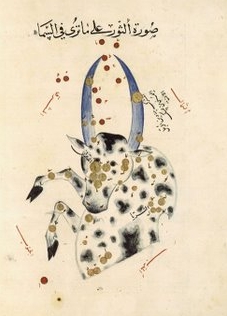
Taurus, drawn as the forequarters of a bull with stars marked in gold
Abd al-Rahman al-Sufi, CC BY-SA 2.0, via Wikimedia Commons
Arabic names in the Book of the Fixed Stars are why Western astronomy uses Arabic star names, even though they were transmitted through translations and intermediaries. Al-Sufi named stars in one of two ways: by the Arabic translation of a Greek descriptive phrase, or by indigenous Arabic names from pre-Islamic Bedouin culture. Fomalhaut belongs to the first group, from fam al-hut, “mouth of the fish,” a direct rendering of Ptolemy’s description of that star’s place in Piscis Austrinus. Betelgeuse belongs to the second. It comes from yad al-Jauza, “hand of al-Jauza,” where al-Jauza is an indigenous Arabic figure rather than a translation of Orion, and the name reached Europe garbled: a scribe misread the initial Arabic letter as a b, and Betelgeuse is the result. The Bedouin names came largely from the the anwa’ system, a calendar built on the 28 lunar mansions and their heliacal risings, the moment when a star first rises just before sunrise after a stretch of invisibility too close to the Sun to be seen. He documented both traditions, which is why both remain in modern use.
The anwa tradition is worth a closer investigation, as it is most likely as old as the Greek traditions. The pre-Islamic Bedouin calendar used the heliacal risings and settings of specific asterisms to mark the seasons, dividing the year into periods named after the relevant star. This was a sophisticated observational tradition built around long-distance navigation across trackless desert and around the timing of seasonal rains. By preserving these names alongside the Greek-descriptive ones, al-Sufi prevented older indigenous astronomy from being entirely absorbed into the imported Greek framework. The two layers sit side by side in his catalog and still do in the modern naming record.
The golden age of Islam

Lepus in both orientations, with its star table below
Abd al-Rahman al-Sufi, CC BY-SA 2.0, via Wikimedia Commons
The Islamic Golden Age of astronomy spanned roughly the 8th to the 15th century CE. During that time states funded astronomy centers and observatories in Baghdad, Damascus, Maragheh.
Major scholars emerged, including al-Khwarizmi, an expert in mathematics and astronomy; al-Battani, who refined planetary motion; al-Biruni, known for geodesy and astronomy; al-Tusi, who worked on planetary models; and Ibn al-Shatir, whose planetary models anticipated elements of Copernicus by over 150 years.
The centers produced hundreds of years of celestial data; Maragheh, founded in 1259 by Hulagu Khan, employed dozens of astronomers and produced star tables referenced for centuries. Samarkand, under Ulugh Beg in the 1420s, included a mural sextant with a radius of nearly 40 meters, the largest astronomical instrument built anywhere in the world at that time.
How the names crossed to Europe
From the 12th century onward, avenues for scientific inquiry in Europe multiplied. Monasteries were no longer the only place learning happened, and the new universities and translation centers created demand for texts the Latin West did not have. The Toledo School of Translators, in the Iberian Peninsula with its history of Christian, Muslim, and Jewish coexistence, served as a primary bridge for new knowledge of Arabic astronomy.
Translation work in Toledo began in the 12th century, well before Alfonso X. Gerard of Cremona alone produced a Latin Almagest there around 1175, along with dozens of other scientific texts. The Alfonsine Tables were compiled near the end of that arc, written Toledo under Alfonso X of Castile (1252 to 1284). They were planetary tables, descended from al-Zarqali’s earlier Toledan Tables, used to calculate the positions of the Sun, Moon, and planets and to predict the times of celestial events. Al-Sufi’s contribution traveled a separate route. His catalog was a star catalog rather than a planetary theory, and what it carried into Europe were the corrected positions, the magnitudes, and, above all, the names.
Even so, progress was not linear: new works arrived through Jewish translators, Iberian intermediaries, and multiple stages of retranslation, and new knowledge trickled in. By the time European astronomers were citing “Aldebaran” or “Betelgeuse” as part of standard practice, most had no idea the names had passed through four or five hands before reaching them.
One such example is Johann Bayer’s work, Uranometria (1603), a celestial atlas that used Greek and Latin letters for star designations and drew on Arabic-corrected Greek astronomy. The Arabic star names that entered Latin astronomy this way are still in use today.