
The Rhythm of the Spheres
Reading the Night Sky
Wandering in Astronomy
The night sky is the oldest pattern of man, and every culture reads it differently. The stars above keep silent time, moving to a rhythm we are just now beginning to understand. Astronomy is where math, science, art, music, and words meet in a wondrous collision. In this section of our site, learn the basics of astronomy: from how a star chart is made, to projections and art that map the night sky, to how an astrolabe works just like it did thousands of years ago. Watch the North Star shift across centuries, explore how one sky has been mapped by many traditions, read what happened on this day in space, and see tonight’s moon for your location.
Map the Stars
The math behind star charts, with a projection explorer and a working astrolabe.
The Moving Sky
How the sky shifts across centuries, with a precession clock you can run.
The Traditions
One sky reads many ways, with a same-sky overlay of the world’s constellations.
This Day in the Stars
The sky’s events, discoveries, and lore tied to today’s date.
The Moon Tonight
Its phase and face, drawn live for where you’re standing.
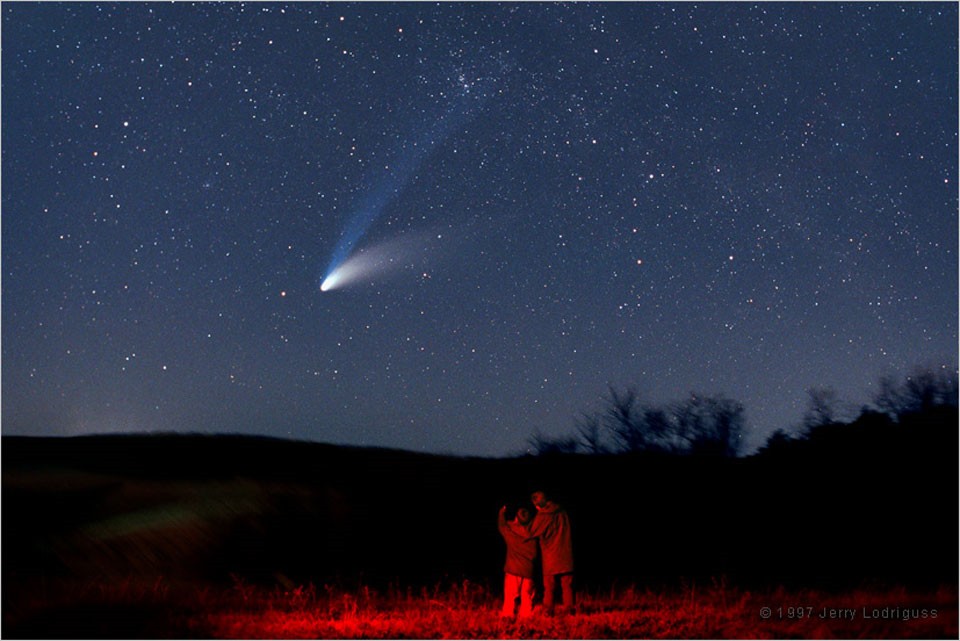
Hale-Bopp: The Great Comet of 1997

Customized Star Charts Coming 1st Quarter 2027
We respect your privacy. Unsubscribe at any time.
Huge new Webb image is chock-full of space delights
ESA has unveiled a spectacular new Webb image. One of the largest shots yet, it features protostars, jets, distant spiral galaxies and a gravitational lens.
ReadSee the year’s fastest sunsets and sunrises around equinoxes
The year's fastest sunsets and sunrises happen around the equinoxes, and the slowest sunsets and sunrises happen around the solstices.
ReadEquinox fun: Track the sun’s shift now until the solstice
On this equinox, start tracking the sunset point on your western horizon. You'll see a mighty shift between now and the June solstice.
ReadThe Sky Today on Thursday, September 17: The Moon and the Scorpion
Looking for a sky event this week? Check out our full Sky This Week column. September 16: Triangle in the sky The Moon passes 0.6° south of the bright star Antares at 9 A.M. EDT. B…
ReadAutumn observing targets for large telescopes
Today I’ll be telling you about 10 of my favorite autumn deep-sky objects, with suggestions for viewing them. I hope you’ll enjoy this list, and I’ll share some other deep-sky fav…
ReadMuon rings enable precise calibration of telescopes at the Cherenkov Telescope Array Observatory
Research initiated as part of a bachelor's thesis in physics at the Universitat Autònoma de Barcelona (UAB) has culminated in a new analytical description of the muon-based calibration of dual-mir…
ReadWhy we need in-orbit refueling to return to the Moon
When the Artemis 2 crew splashed down in the Pacific Ocean on April 10, the excitement was palpable — Reid Wiseman, Victor Glover, Christina Koch, and Jeremy Hansen had swung around the Moon, bro…
ReadNearly 50 'ghost galaxies' emerge around three hosts, challenging dwarf galaxy counts
Dwarf galaxies—with a mass equal to about a billion suns, but often considerably less—are the most abundant in the universe. However, because of their low luminosity, they are very difficult to…
ReadWebb measures extreme gas outflows from distant 'dead' galaxies
Astronomers using the James Webb Space Telescope have measured the most powerful gas outflow ever recorded from a "dead" galaxy outside our cosmic neighborhood and found that even outflows this ext…
Read