
The Rhythm of the Spheres
Reading the Night Sky
Wandering in Astronomy
The night sky is the oldest pattern of man, and every culture reads it differently. The stars above keep silent time, moving to a rhythm we are just now beginning to understand. Astronomy is where math, science, art, music, and words meet in a wondrous collision. In this section of our site, learn the basics of astronomy: from how a star chart is made, to projections and art that map the night sky, to how an astrolabe works just like it did thousands of years ago. Watch the North Star shift across centuries, explore how one sky has been mapped by many traditions, read what happened on this day in space, and see tonight’s moon for your location.
Map the Stars
The math behind star charts, with a projection explorer and a working astrolabe.
The Moving Sky
How the sky shifts across centuries, with a precession clock you can run.
The Traditions
One sky reads many ways, with a same-sky overlay of the world’s constellations.
This Day in the Stars
The sky’s events, discoveries, and lore tied to today’s date.
The Moon Tonight
Its phase and face, drawn live for where you’re standing.
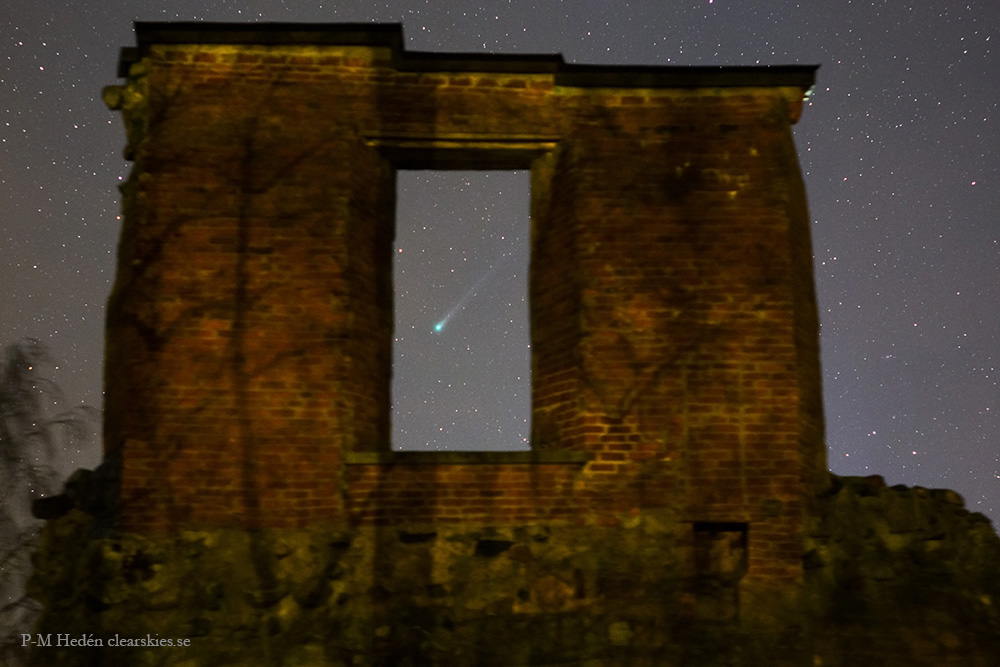
Comet Lovejoy through M�rby Castle Ruins

Customized Star Charts Coming 1st Quarter 2027
We respect your privacy. Unsubscribe at any time.
Sun news: 3 events to notice on today’s sun
Sun news September 22, 2026: We're poised for the September equinox. And we speak of 3 events today: the return of sunspots, C flares and fast solar wind.
ReadJUICE mission to fly by Earth next week! Details here
The JUICE mission will perform a flyby of Earth next week. The spacecraft is headed toward Jupiter's icy moons, where it will arrive in 2031.
ReadThe Sky Today on Tuesday, September 22: The autumnal equinox
Looking for a sky event this week? Check out our full Sky This Week column. September 21: Saturn passes a field star The autumnal equinox occurs at 8:05 P.M. EDT. This moment marks …
ReadA 42-light-year X-ray tail links a pulsar to previously 'orphan' gamma rays
Understanding the origin, acceleration and propagation of high-energy cosmic rays has been a century-old mystery in astrophysics. Recently, joint observations from China's Einstein Probe (EP) satel…
ReadAre day and night equal on the equinox? Not exactly
Are day and night equal at an equinox? No. There's slightly more day than night on the day of an equinox. Find out why here.
ReadSolar Orbiter catches the sun's missing high-speed vibrations
The sun's magnetic fields are a twisty, curvy, ever-changing mess. In particular, our star's polar regions host areas called polar coronal holes, which contain invisible magnetic highways that stre…
ReadChina targets two launches as SpaceX takes It easy
Rocket launches this week On Wednesday, Sept. 23, at 9:30 a.m. EDT, the China Aerospace Science and Technology Corporation (CASC), the state-owned contractor that builds the Long March rocket famil…
ReadSuperdense neutron star caught feeding on a blue hypergiant's stellar wind
Using data from the Japan–led XRISM (X-ray Imaging and Spectroscopy Mission) observatory, astronomers have directly observed a giant star's outflow, called a stellar wind, being captured by its c…
ReadBy any other name: NGC 1269 or NGC 1291?
The galaxy you see here has an identity crisis. Scottish astronomer James Dunlop discovered it in 1826, and John Dreyer included it as the 1,291st entry in his New General Catalogue. Ten years afte…
Read