
The Rhythm of the Spheres
Reading the Night Sky
Wandering in Astronomy
The night sky is the oldest pattern of man, and every culture reads it differently. The stars above keep silent time, moving to a rhythm we are just now beginning to understand. Astronomy is where math, science, art, music, and words meet in a wondrous collision. In this section of our site, learn the basics of astronomy: from how a star chart is made, to projections and art that map the night sky, to how an astrolabe works just like it did thousands of years ago. Watch the North Star shift across centuries, explore how one sky has been mapped by many traditions, read what happened on this day in space, and see tonight’s moon for your location.
Map the Stars
The math behind star charts, with a projection explorer and a working astrolabe.
The Moving Sky
How the sky shifts across centuries, with a precession clock you can run.
The Traditions
One sky reads many ways, with a same-sky overlay of the world’s constellations.
This Day in the Stars
The sky’s events, discoveries, and lore tied to today’s date.
The Moon Tonight
Its phase and face, drawn live for where you’re standing.
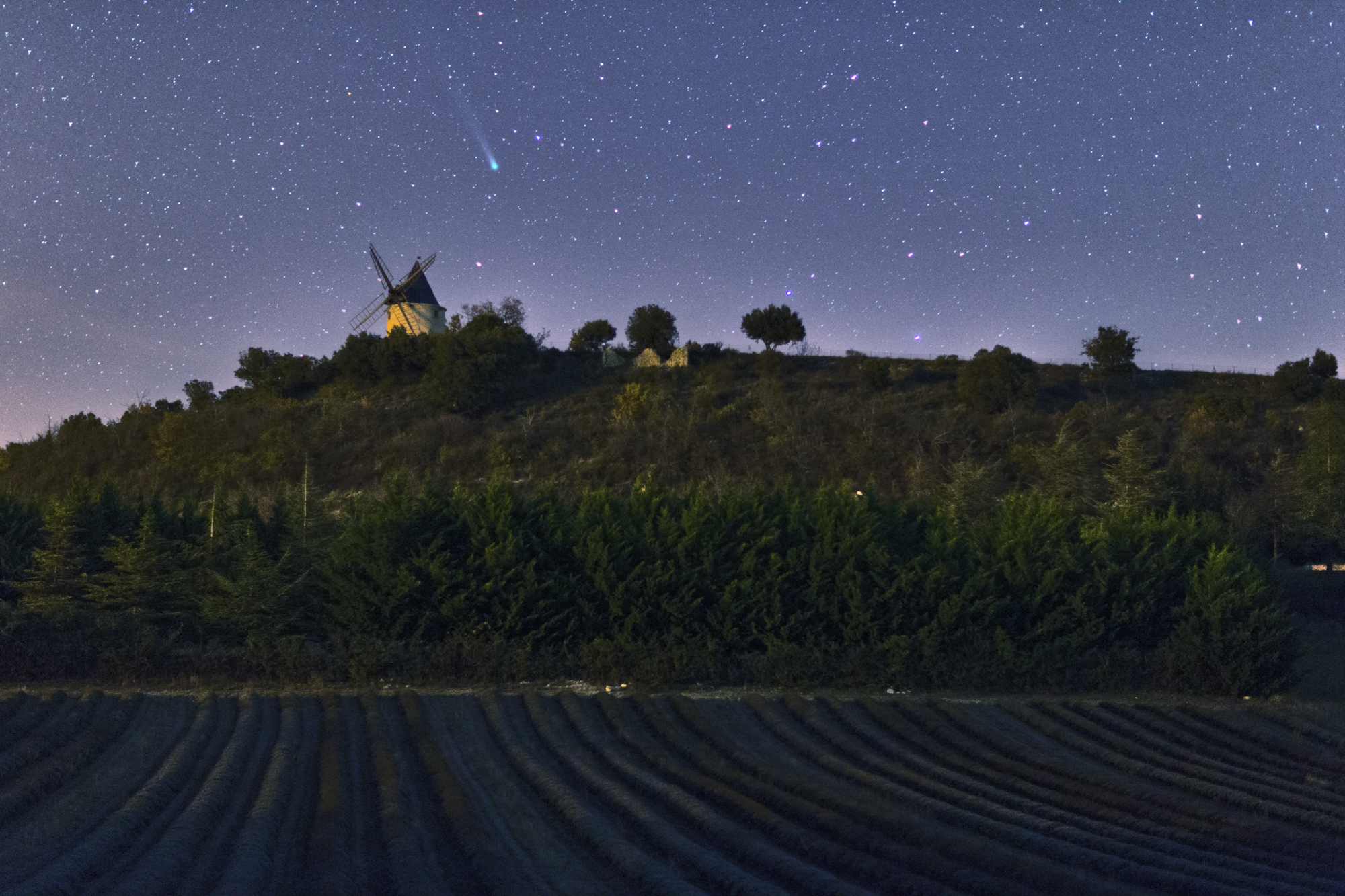
Comet Lovejoy Over a Windmill

Customized Star Charts Coming 1st Quarter 2027
We respect your privacy. Unsubscribe at any time.
Hurricane Polo explodes into a Category 5 storm off Mexico
Hurricane Polo has undergone rapid intensification just off the southwestern coast of Mexico. It went from a tropical storm to a category 5 hurricane in a day.
ReadHave astronomers discovered the first moon outside of our solar system?
In a new study, astronomers detail observations of what could be the first known exosatellite — a natural object orbiting a world beyond our solar system in the same way our Moon orbits Earth. Ho…
Read2026 Full Moon calendar: When to see the Full Moon and phases
The phenomenon of a Full Moon arises when our planet, Earth, is precisely sandwiched between the Sun and the Moon. This alignment ensures the entire side of the Moon that faces us gleams under sunl…
ReadSept. 22, 1791: The birth of Michael Faraday
Although he was primarily known as a chemist, Michael Faraday’s research into electricity and magnetism underpin much of our understanding of the universe and modern physics. Born Sept. 22, 1791,…
ReadVisible planets and night sky guide for September
Visible planets and night sky guide: Happy equinox! What is the equinox and why does it matter? And, most importantly, how can you experience it?
ReadSun news: 3 events to notice on today’s sun
Sun news September 22, 2026: We're poised for the September equinox. And we speak of 3 events today: the return of sunspots, C flares and fast solar wind.
ReadA 42-light-year X-ray tail links a pulsar to previously 'orphan' gamma rays
Understanding the origin, acceleration and propagation of high-energy cosmic rays has been a century-old mystery in astrophysics. Recently, joint observations from China's Einstein Probe (EP) satel…
ReadSolar Orbiter catches the sun's missing high-speed vibrations
The sun's magnetic fields are a twisty, curvy, ever-changing mess. In particular, our star's polar regions host areas called polar coronal holes, which contain invisible magnetic highways that stre…
ReadSuperdense neutron star caught feeding on a blue hypergiant's stellar wind
Using data from the Japan–led XRISM (X-ray Imaging and Spectroscopy Mission) observatory, astronomers have directly observed a giant star's outflow, called a stellar wind, being captured by its c…
Read