
The Rhythm of the Spheres
Reading the Night Sky
Wandering in Astronomy
The night sky is the oldest pattern of man, and every culture reads it differently. The stars above keep silent time, moving to a rhythm we are just now beginning to understand. Astronomy is where math, science, art, music, and words meet in a wondrous collision. In this section of our site, learn the basics of astronomy: from how a star chart is made, to projections and art that map the night sky, to how an astrolabe works just like it did thousands of years ago. Watch the North Star shift across centuries, explore how one sky has been mapped by many traditions, read what happened on this day in space, and see tonight’s moon for your location.
Map the Stars
The math behind star charts, with a projection explorer and a working astrolabe.
The Moving Sky
How the sky shifts across centuries, with a precession clock you can run.
The Traditions
One sky reads many ways, with a same-sky overlay of the world’s constellations.
This Day in the Stars
The sky’s events, discoveries, and lore tied to today’s date.
The Moon Tonight
Its phase and face, drawn live for where you’re standing.
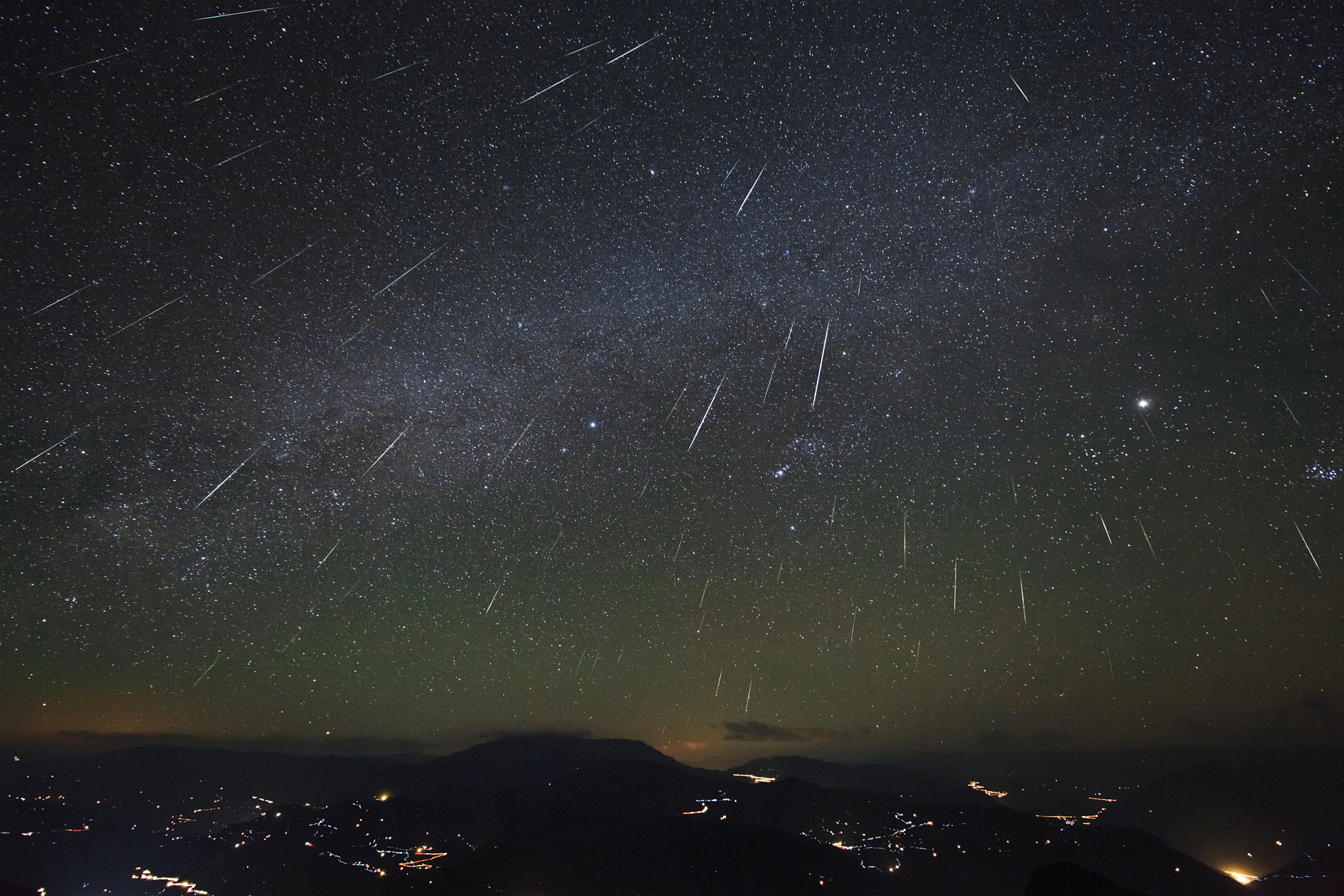
Geminid Meteor Shower over Dashanbao Wetlands

Customized Star Charts Coming 1st Quarter 2027
We respect your privacy. Unsubscribe at any time.
Finding light’s true nature
Light exhibits some of the strangest properties in our cosmos. It manifests as both a wave and a particle, and its speed in a vacuum is invariant. While physicists now fully grasp the way light int…
Read2026 Full Moon calendar: When to see the Full Moon and phases
The phenomenon of a Full Moon arises when our planet, Earth, is precisely sandwiched between the Sun and the Moon. This alignment ensures the entire side of the Moon that faces us gleams under sunl…
ReadSept. 23, 1846: Johann Galle discovers Neptune
For decades following the discovery of Uranus in 1781, astronomers were puzzled by the irregularities in the planet’s orbit. Newton’s laws could not explain the perturbations, suggesting anothe…
ReadBaby exoplanet: Astronomers find the youngest world yet
Astronomers have discovered the youngest-known exoplanet so far, Elias 2-24 b. The baby exoplanet is twice the mass of Jupiter and 450 light-years away.
ReadSun news: Solar wind gust could spark auroras
Sun news September 23, 2026: NOAA issued a G1 storm alert as coronal hole wind arrives tonight. Could the equinox effect give auroras a boost?
ReadHurricane Polo lurks off Mexico, now Category 4
Hurricane Polo has weakened to Category 4 as it moves north along Mexico's southwestern coast. It had strengthened from a tropical storm to Category 5 in a day.
ReadLargest dataset of its kind could clarify how massive stars shaped early galaxies
The more astronomers learn about the universe's earliest galaxies, the stranger they seem. Many of their surprising properties may be explained by differences between their massive stars and those …
ReadAstronomers detect radio signals coming from an exoplanet for the first time
Exoplanets are exotic worlds orbiting distant stars far beyond our solar system. Ever since the first ones were discovered in the 1990s, astronomers have turned their attention to these distant wor…
ReadMilky Way's first microblazar may produce fastest particles in the galaxy
An international team of astronomers from ASTRON, JIVE, the University of Amsterdam and other institutions has found the first so-called "microblazar" in the Milky Way. This stellar system is compo…
Read