

The Rhythm of the Spheres
Reading the Night Sky
Wandering in Astronomy
The night sky is the oldest pattern of man, and every culture reads it differently. The stars above keep silent time, moving to a rhythm we are just now beginning to understand. Astronomy is where math, science, art, music, and words meet in a wondrous collision. In this section of our site, learn the basics of astronomy: from how a star chart is made, to projections and art that map the night sky, to how an astrolabe works just like it did thousands of years ago. Watch the North Star shift across centuries, explore how one sky has been mapped by many traditions, read what happened on this day in space, and see tonight’s moon for your location.
Map the Stars
The math behind star charts, with a projection explorer and a working astrolabe.
The Moving Sky
How the sky shifts across centuries, with a precession clock you can run.
The Traditions
One sky reads many ways, with a same-sky overlay of the world’s constellations.
This Day in the Stars
The sky’s events, discoveries, and lore tied to today’s date.
The Moon Tonight
Its phase and face, drawn live for where you’re standing.
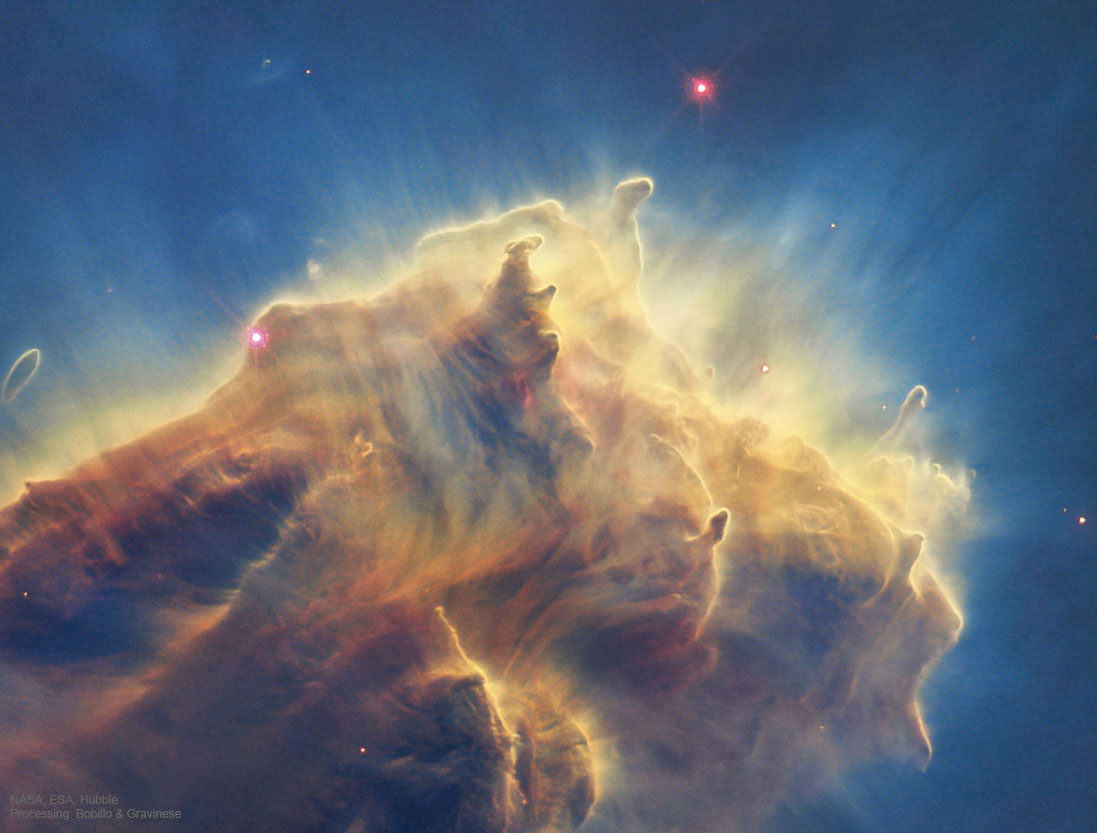
Star Formation in the Eagle Nebula

Customized Star Charts Coming 1st Quarter 2027
We respect your privacy. Unsubscribe at any time.
How to watch Starship Flight 15
SpaceX is set to launch its 15th test flight of Starship on Friday, Nov. 13. For the first time, the company will try to catch both stages of the rocket — the Super Heavy booster and the upper st…
ReadA likely supermassive neutron star might shed light on the mass gap between neutron stars and black holes
A team of astronomers recently identified a red giant star with an unseen binary companion after examining data from the Large Sky Area MultiObject Fiber Spectroscopic Telescope (LAMOST) and the Ap…
ReadGemini and DECam showcase a young Type Ia supernova
A star's explosive demise has added a shiny new feature to NGC 1433, a barred spiral galaxy approximately 50 million light-years away in the southern constellation Horologium (the Pendulum Clock). …
ReadREVIEW: Spectrum Optics SkyPilot 127
The smart telescope revolution has grown rapidly over the past few years. Most of these scopes focus primarily on electronic imaging, though, and while amateur astronomers may marvel at the images,…
ReadNov. 13, 1971: Mariner 9 orbits Mars
On May 30, 1971, Mariner 9 launched, setting off on its mission to Mars. On Nov. 13, 167 days later, it entered orbit around Mars, making it the first spacecraft to orbit another planet. With Marin…
ReadEuclid's first data release: A stepping stone to its 3D map of the sky
The ESA's Euclid has already teased us with some early results. In the past, it's given us a small image covering 60 square degrees of the sky, created with a few days of observations. Those images…
ReadMountain-sized asteroid 1999 AN10 to pass close to Earth in 2027
Asteroid 1999 AN10, which might be a mile wide, will pass Earth on August 7, 2027, about 1 lunar distance away. The encounter poses no danger.
ReadSun news: How the sun stripped Mars of its air
Sun news November 13, 2026: A year ago, the ESCAPDE spacecraft launched toward Mars. And this mission will also be monitoring the sun.
ReadMirach is your guide star to finding 3 galaxies
Mirach in the constellation Andromeda helps stargazers locate the Andromeda Galaxy, the Triangulum Galaxy, and "Mirach's Ghost."
Read