

The Rhythm of the Spheres
Reading the Night Sky
Wandering in Astronomy
The night sky is the oldest pattern of man, and every culture reads it differently. The stars above keep silent time, moving to a rhythm we are just now beginning to understand. Astronomy is where math, science, art, music, and words meet in a wondrous collision. In this section of our site, learn the basics of astronomy: from how a star chart is made, to projections and art that map the night sky, to how an astrolabe works just like it did thousands of years ago. Watch the North Star shift across centuries, explore how one sky has been mapped by many traditions, read what happened on this day in space, and see tonight’s moon for your location.
Map the Stars
The math behind star charts, with a projection explorer and a working astrolabe.
The Moving Sky
How the sky shifts across centuries, with a precession clock you can run.
The Traditions
One sky reads many ways, with a same-sky overlay of the world’s constellations.
This Day in the Stars
The sky’s events, discoveries, and lore tied to today’s date.
The Moon Tonight
Its phase and face, drawn live for where you’re standing.
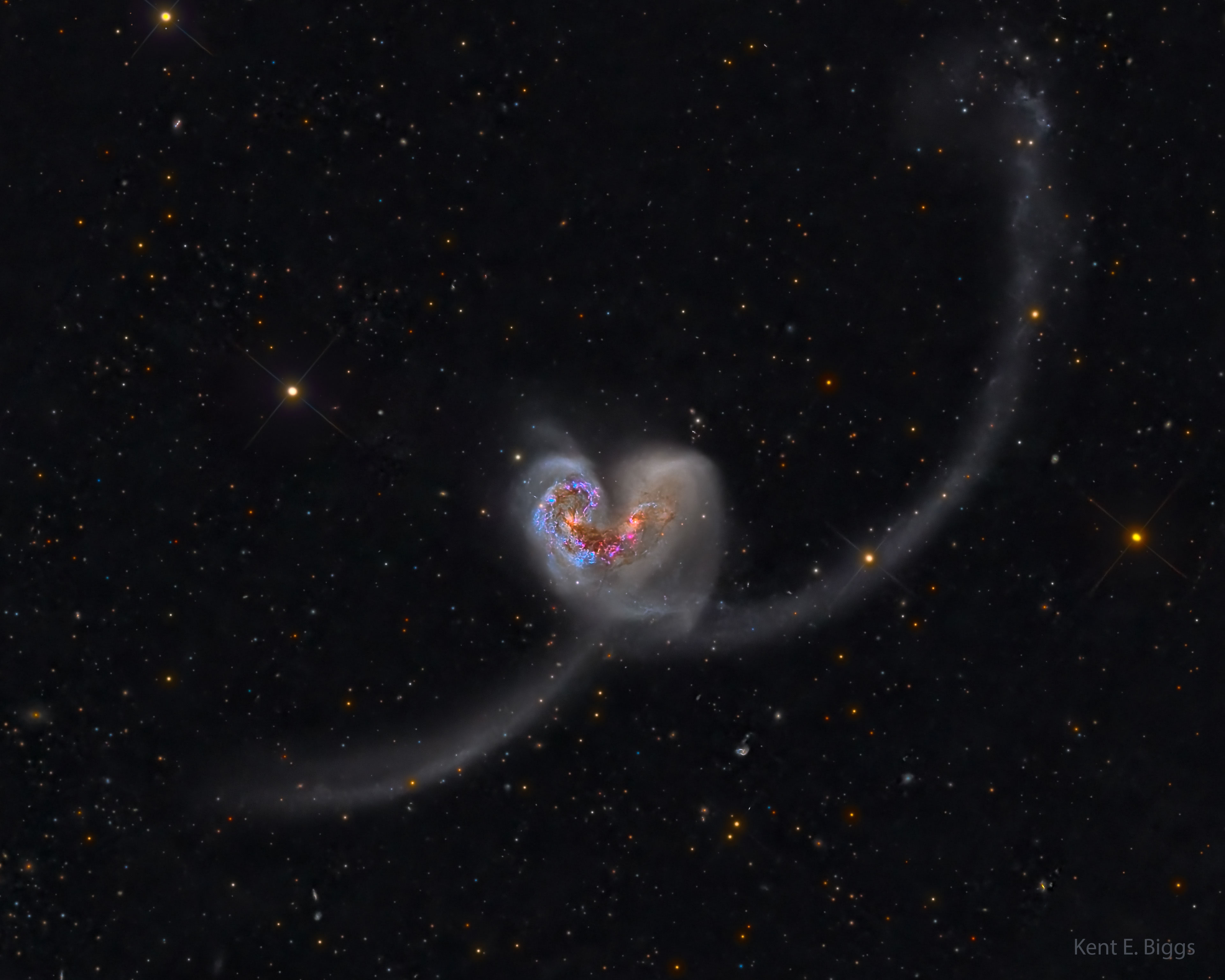
The Heart Shaped Antennae Galaxies
Open Science: Browse 3,300+ codes in the Astrophysics Source Code Library

Customized Star Charts Coming 1st Quarter 2027
We respect your privacy. Unsubscribe at any time.
Vibrating mirrors of light create analog of a black hole event horizon
Optical cavities are pairs of light-trapping mirrors and underpin the operation of lasers, atomic clocks and many types of precision sensors. If the distance between the mirrors is changed rapidly …
ReadWacky magnetic fields of ice giants may stem from conductivity changes in their deep interiors
When NASA's Voyager 2 robotic probe flew by Uranus and Neptune in the 1980s, it uncovered an anomaly: their magnetic fields are highly disordered, unlike Earth's, which has well-defined north and s…
ReadNov. 6, 1919: Einstein is right
The earliest test of Albert Einstein’s general theory of relativity took place just four years after he published it. During the May 29, 1919, total solar eclipse, British astronomer Sir Arthur E…
Read2026 Full Moon calendar: When to see the Full Moon and phases
The phenomenon of a Full Moon arises when our planet, Earth, is precisely sandwiched between the Sun and the Moon. This alignment ensures the entire side of the Moon that faces us gleams under sunl…
ReadActive volcanoes on Mars? Noxious gas discovery says — maybe
Are there still active volcanoes on Mars? New detections of hydrogen chloride from below the surface suggest flowing magma.
ReadA galaxy nicknamed Misty Moons offers a glimpse of early star formation
Gravitational lensing is one of astronomy's best tricks for seeing the early universe. When a massive galaxy cluster sits in between the observer and a distant object, its gravity bends and magnifi…
ReadTraces of dinosaur blood found for the 1st time?
For the 1st time, scientists say they've found traces of dinosaur blood. It comes from a 115-million-year-old fossil dinosaur bone from Brazil.
ReadSun news: Our star awakens with an M flare
Sun news November 6, 2026: Bam! Sunspot AR4566 fired an M3.5 flare and sent sun-stuff soaring into space. Is any heading to Earth?
ReadThe Sky Today on Friday, November 6: Nab the North America Nebula
Looking for a sky event this week? Check out our full Sky This Week column. November 5: Smoke out the Southern Cigar As fall gets into full swing, we are seeing less of the summerti…
Read