

The Rhythm of the Spheres
Reading the Night Sky
Wandering in Astronomy
The night sky is the oldest pattern of man, and every culture reads it differently. The stars above keep silent time, moving to a rhythm we are just now beginning to understand. Astronomy is where math, science, art, music, and words meet in a wondrous collision. In this section of our site, learn the basics of astronomy: from how a star chart is made, to projections and art that map the night sky, to how an astrolabe works just like it did thousands of years ago. Watch the North Star shift across centuries, explore how one sky has been mapped by many traditions, read what happened on this day in space, and see tonight’s moon for your location.
Map the Stars
The math behind star charts, with a projection explorer and a working astrolabe.
The Moving Sky
How the sky shifts across centuries, with a precession clock you can run.
The Traditions
One sky reads many ways, with a same-sky overlay of the world’s constellations.
This Day in the Stars
The sky’s events, discoveries, and lore tied to today’s date.
The Moon Tonight
Its phase and face, drawn live for where you’re standing.
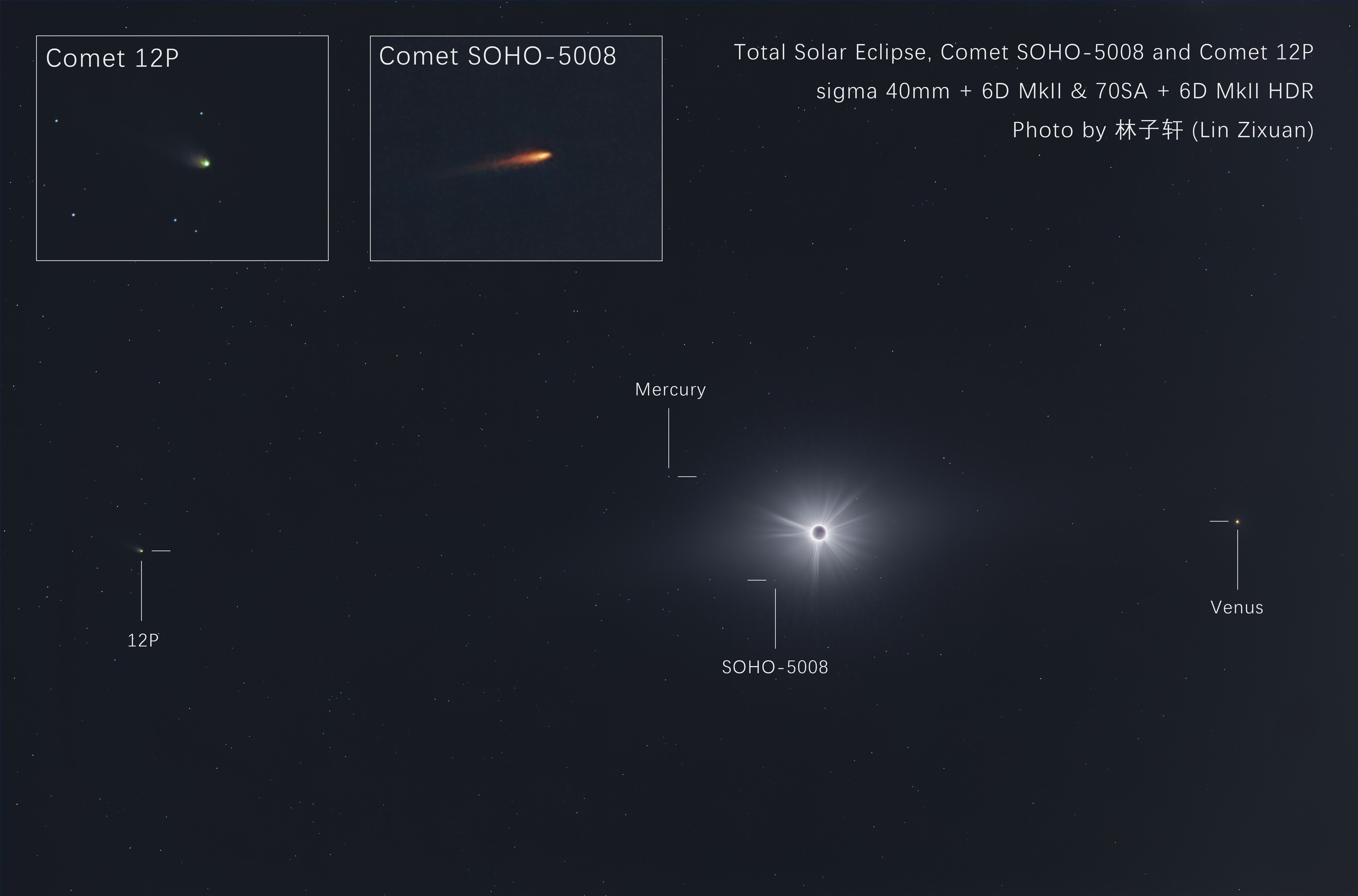
Total Eclipse and Comets
Solar Eclipse Imagery: Notable Submissions to APOD

Customized Star Charts Coming 1st Quarter 2027
We respect your privacy. Unsubscribe at any time.
Heavy hydrogen in 3I/ATLAS's methane points to a frigid birthplace
The interstellar comet 3I/ATLAS carries a chemical clue to conditions in the planetary system of its origin, locked away long before it reached our sun. Its methane signature is unusually rich in h…
ReadDid comets seed life on Earth? A new study says — probably not
Did comets seed life on Earth? It's unlikely, a new study from the University of Cambridge says. It would have been a very rare occurrence.
ReadDo black holes split into smaller black holes?
Black holes sometimes merge. But could 1 split into 2 or more? A new study explores the conditions that might allow it, including extremely rapid rotation.
ReadDid the Viking 2 lander detect marsquakes in 1976?
New analysis shows that 2 possible marsquakes detected by Viking 2 were in the same region as nearly 1,000 others detected by the InSight lander decades later.
ReadThe Sky Today on Sunday, November 1: The Moon in Cancer
Looking for a sky event this week? Check out our full Sky This Week column. October 31: Glimpse the ghostly Phantom Galaxy Daylight saving time ends at 2 A.M. local daylight time th…
ReadNovember 2026: What’s in the sky this month?
Saturn is already visible as darkness falls; some challenging transits of its moons occur this month. Neptune is a binocular object close to Saturn, while Uranus is an easy target in Taurus. A Full…
ReadNovember 2026: What’s in the Southern Hemisphere sky this month?
Although Venus has dominated the evening sky since last summer, its long apparition came to an end at inferior conjunction in late October. That leaves Saturn as the only naked-eye planet visible a…
ReadFiguring out where cosmic neutrinos come from is tricky—radio telescopes could help find 'ghost particles' origin
Neutrinos are funny little particles that weigh almost nothing, making them one of the universe's most elusive building blocks. They can come from objects as mundane as bananas and as exotic as sup…
ReadTiny photonic chip links telescopes together to view the universe in 'astonishing' detail
A tiny glass chip developed by researchers at Heriot-Watt University has linked two telescopes together to enable them to act as a single powerful instrument, marking an important step toward a new…
Read