

The Rhythm of the Spheres
Reading the Night Sky
Wandering in Astronomy
The night sky is the oldest pattern of man, and every culture reads it differently. The stars above keep silent time, moving to a rhythm we are just now beginning to understand. Astronomy is where math, science, art, music, and words meet in a wondrous collision. In this section of our site, learn the basics of astronomy: from how a star chart is made, to projections and art that map the night sky, to how an astrolabe works just like it did thousands of years ago. Watch the North Star shift across centuries, explore how one sky has been mapped by many traditions, read what happened on this day in space, and see tonight’s moon for your location.
Map the Stars
The math behind star charts, with a projection explorer and a working astrolabe.
The Moving Sky
How the sky shifts across centuries, with a precession clock you can run.
The Traditions
One sky reads many ways, with a same-sky overlay of the world’s constellations.
This Day in the Stars
The sky’s events, discoveries, and lore tied to today’s date.
The Moon Tonight
Its phase and face, drawn live for where you’re standing.
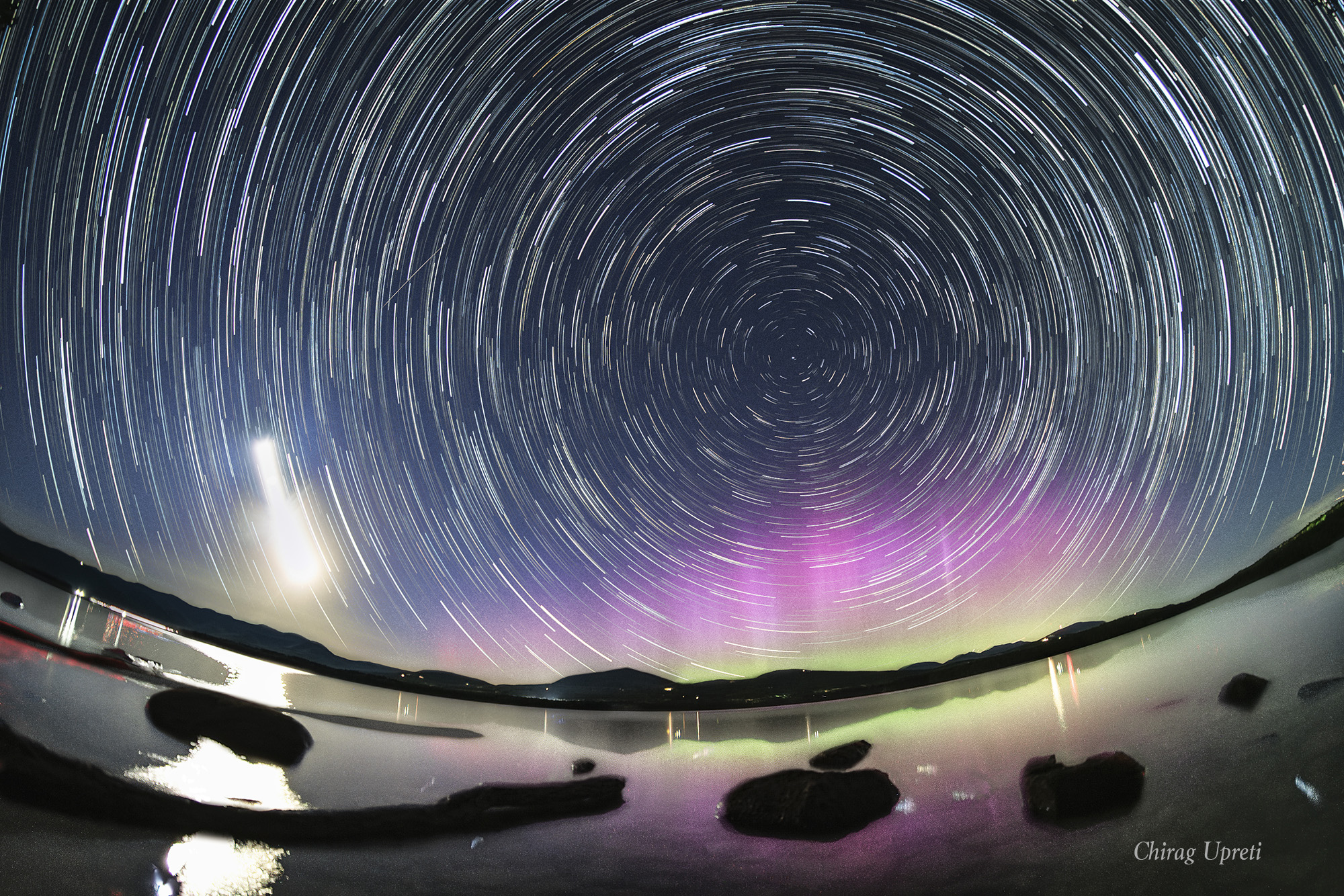
North Celestial Aurora
AuroraSaurus: Report your aurora observations

Customized Star Charts Coming 1st Quarter 2027
We respect your privacy. Unsubscribe at any time.
Figuring out where cosmic neutrinos come from is tricky—radio telescopes could help find 'ghost particles' origin
Neutrinos are funny little particles that weigh almost nothing, making them one of the universe's most elusive building blocks. They can come from objects as mundane as bananas and as exotic as sup…
ReadTiny photonic chip links telescopes together to view the universe in 'astonishing' detail
A tiny glass chip developed by researchers at Heriot-Watt University has linked two telescopes together to enable them to act as a single powerful instrument, marking an important step toward a new…
ReadA gamma-ray powerhouse's smoking gun? Gas trail points to microquasar jets
In 2016, a binary star system emitting unusually strong gamma rays was discovered in our galactic neighborhood. Now, astronomers have found the smoking gun, or rather, a smoking trail of cool molec…
ReadRubin spots possible dwarf planet
The Vera C. Rubin Observatory may have found its first dwarf planet. Orbiting beyond Pluto, the object may also be one of the brightest and biggest in that stretch of the solar system. Matthew Holm…
Read2026 Full Moon calendar: When to see the Full Moon and phases
The phenomenon of a Full Moon arises when our planet, Earth, is precisely sandwiched between the Sun and the Moon. This alignment ensures the entire side of the Moon that faces us gleams under sunl…
ReadNew dwarf planet discovered by Rubin?
Astronomers using the Rubin Observatory have discovered a new dwarf planet candidate. It lies just beyond the orbit of Pluto.
ReadGhostly white animals: What’s the cause?
Happy Halloween! They might look ghostly, but white animals are not ghosts. Here's the science behind why some creatures lose their color.
ReadCould the Taurid meteors bring a risk of airbursts in 2026?
A researcher says the Taurid meteor shower could bring an increased risk of an airburst in 2026. But these Halloween fireballs are based on 2 big IFs.
ReadThe Sky Today on Friday, October 30: Mars approaches Leo
Looking for a sky event this week? Check out our full Sky This Week column. October 29: Open cluster Collinder 463 Magnitude 0.8 Mars, currently tracking eastward through the sky, n…
Read