

The Rhythm of the Spheres
Reading the Night Sky
Wandering in Astronomy
The night sky is the oldest pattern of man, and every culture reads it differently. The stars above keep silent time, moving to a rhythm we are just now beginning to understand. Astronomy is where math, science, art, music, and words meet in a wondrous collision. In this section of our site, learn the basics of astronomy: from how a star chart is made, to projections and art that map the night sky, to how an astrolabe works just like it did thousands of years ago. Watch the North Star shift across centuries, explore how one sky has been mapped by many traditions, read what happened on this day in space, and see tonight’s moon for your location.
Map the Stars
The math behind star charts, with a projection explorer and a working astrolabe.
The Moving Sky
How the sky shifts across centuries, with a precession clock you can run.
The Traditions
One sky reads many ways, with a same-sky overlay of the world’s constellations.
This Day in the Stars
The sky’s events, discoveries, and lore tied to today’s date.
The Moon Tonight
Its phase and face, drawn live for where you’re standing.
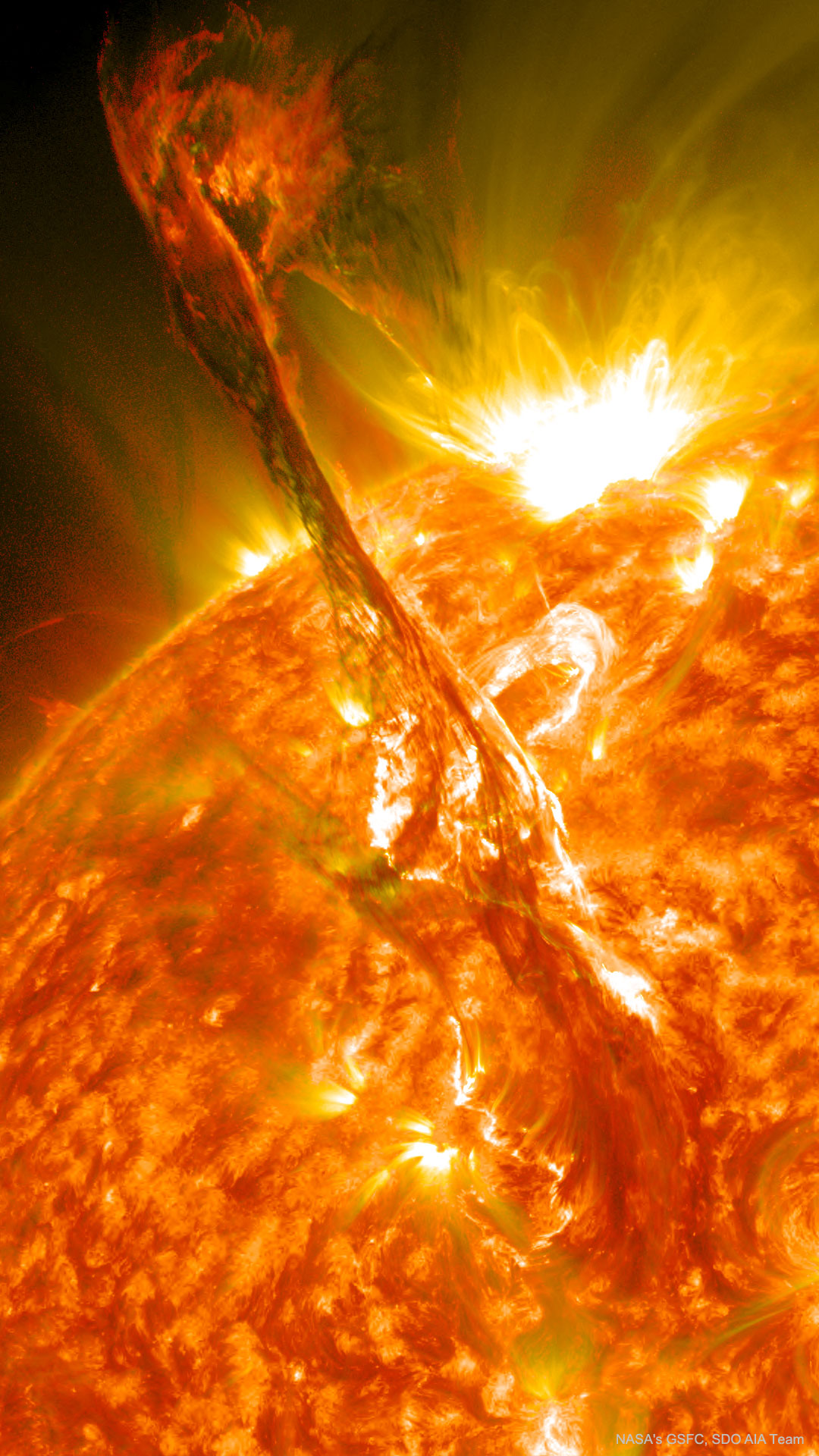
A Solar Filament Erupts
Your Sky Surprise: What picture did APOD feature on your birthday? (post 1995)

Customized Star Charts Coming 1st Quarter 2027
We respect your privacy. Unsubscribe at any time.
Enormous 'Cat's Tail' tells of cosmic collision 63 light-years away
Sixty-three light-years from Earth, in the small, faint constellation known as Pictor (which is Latin for "painter"), there lies a strange structure that has puzzled astronomers for the last two ye…
ReadGrand Theft Astro: Stars' criminal histories could reshape estimates of their internal magnetic fields
Magnetic fields exist in many stars, including the sun. Yet they remain too poorly understood to be reliably included in stellar evolution models, limiting their accuracy. Now, a new study by resea…
ReadModest gamma-ray flash followed by dazzling afterglow points to powerful stellar jet viewed off-axis
A cosmic explosion that announced itself with a modest flash of gamma rays went on to produce one of the brightest afterglows astronomers have recorded in the past 20 years. An international team o…
Read2026 Full Moon calendar: When to see the Full Moon and phases
The phenomenon of a Full Moon arises when our planet, Earth, is precisely sandwiched between the Sun and the Moon. This alignment ensures the entire side of the Moon that faces us gleams under sunl…
ReadOct. 29, 1998: John Glenn returns to space
John Glenn became the first American to orbit Earth when he blasted off in Friendship 7 on Feb. 20, 1962. His flight made him an American hero during the heights of the Space Race, and the oldest m…
ReadIs this our solar system’s future? Scientists spot disk around dead star
Researchers have discovered a white dwarf surrounded by a debris disk with 2 separate rings. It offers a possible glimpse of our solar system's future.
ReadThe enormous oarfish could inspire new ways to explore the ocean
The giant oarfish has a remarkable fin that could inspire quieter underwater robots and open new possibilities for ocean exploration and conservation.
ReadVisible planets and night sky guide for October and November
Visible planets and night sky guide. Tomorrow morning, the moon will hang near Castor and Pollux, the twin stars of Gemini.
ReadThe Sky Today on Thursday, October 29: Open cluster Collinder 463
Looking for a sky event this week? Check out our full Sky This Week column. October 28: The Moon hangs with Uranus The W-shaped constellation Cassiopeia is prominent in the northern…
Read