

The Rhythm of the Spheres
Reading the Night Sky
Wandering in Astronomy
The night sky is the oldest pattern of man, and every culture reads it differently. The stars above keep silent time, moving to a rhythm we are just now beginning to understand. Astronomy is where math, science, art, music, and words meet in a wondrous collision. In this section of our site, learn the basics of astronomy: from how a star chart is made, to projections and art that map the night sky, to how an astrolabe works just like it did thousands of years ago. Watch the North Star shift across centuries, explore how one sky has been mapped by many traditions, read what happened on this day in space, and see tonight’s moon for your location.
Map the Stars
The math behind star charts, with a projection explorer and a working astrolabe.
The Moving Sky
How the sky shifts across centuries, with a precession clock you can run.
The Traditions
One sky reads many ways, with a same-sky overlay of the world’s constellations.
This Day in the Stars
The sky’s events, discoveries, and lore tied to today’s date.
The Moon Tonight
Its phase and face, drawn live for where you’re standing.
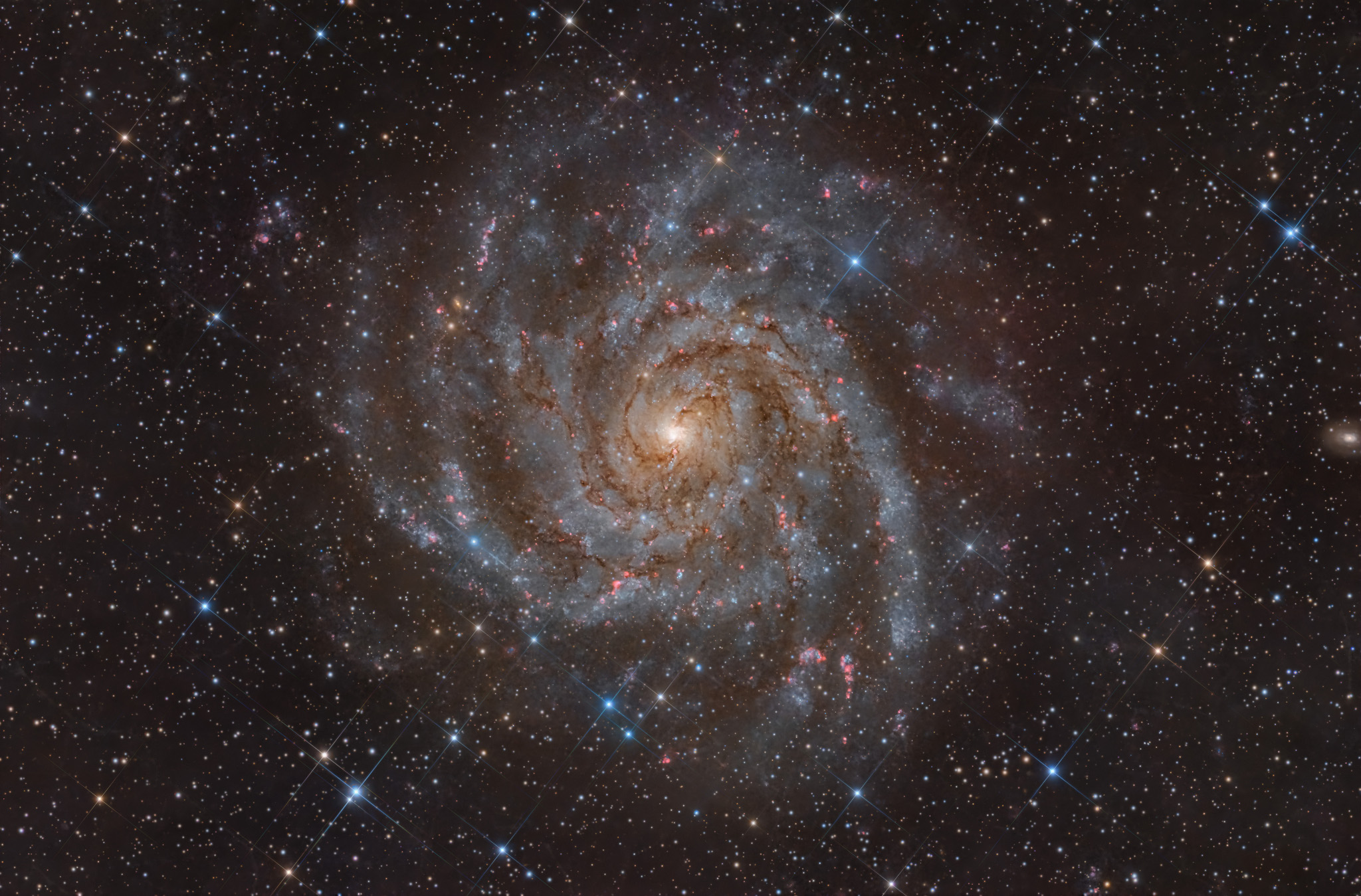
IC 342: Hidden Galaxy in Camelopardalis

Customized Star Charts Coming 1st Quarter 2027
We respect your privacy. Unsubscribe at any time.
2026 Full Moon calendar: When to see the Full Moon and phases
The phenomenon of a Full Moon arises when our planet, Earth, is precisely sandwiched between the Sun and the Moon. This alignment ensures the entire side of the Moon that faces us gleams under sunl…
ReadJWST tracks more than 100 magnified stellar events in the Dragon galaxy
Using the James Webb Space Telescope (JWST), a team of astronomers identified 104 magnified stellar events in a galaxy known as the Dragon, located around 6.5 billion light-years away. This discove…
ReadGemini North reveals Twin Spirits in Pegasus
Three high school students in the Project Hōkūlani internship at Gemini North on Maunakea, Hawaii, chose this pair of clashing spirals, cataloged collectively as NGC 7253 or Arp 278, for imaging …
ReadGame theory helps SETI search for alien civilizations
The search for extraterrestrial intelligence (SETI) is mostly concerned with where to look for technosignatures from another civilization. Between 2012 and 2015, SETI's Project Phoenix targeted abo…
Read'Stupendously large' primordial black holes ruled out as a dark matter source
Primordial black holes are hypothetical objects that could have formed directly from dense clumps of matter in the very early universe. If they exist, their dramatic origins would set them apart fr…
ReadNov. 8, 1656: The birth of Edmond Halley
It’s been said that the general public knows three astronomical objects: the Moon, the rings of Saturn, and Halley’s Comet. English astronomer Edmond Halley, born Nov. 8, 1656, didn’t discove…
ReadBackward world? Rubin finds a retrograde object past Neptune
The Rubin Observatory in Chile has discovered a retrograde object in our solar system. It circles the sun in a highly inclined orbit beyond Neptune.
ReadSun news: Auroras glowed over northern Minnesota last night
Sun news November 8, 2026: Auroras glowed over northern Minnesota as fast solar wind sparked a G1 storm. More could light up the sky tonight!
ReadCarl Sagan born 92 years ago tomorrow
Carl Sagan, born November 9, 1934, brought astronomy to millions through books and the TV series Cosmos. He also helped create messages from Earth for the Pioneer and Voyager spacecraft.
Read