

The Rhythm of the Spheres
Reading the Night Sky
Wandering in Astronomy
The night sky is the oldest pattern of man, and every culture reads it differently. The stars above keep silent time, moving to a rhythm we are just now beginning to understand. Astronomy is where math, science, art, music, and words meet in a wondrous collision. In this section of our site, learn the basics of astronomy: from how a star chart is made, to projections and art that map the night sky, to how an astrolabe works just like it did thousands of years ago. Watch the North Star shift across centuries, explore how one sky has been mapped by many traditions, read what happened on this day in space, and see tonight’s moon for your location.
Map the Stars
The math behind star charts, with a projection explorer and a working astrolabe.
The Moving Sky
How the sky shifts across centuries, with a precession clock you can run.
The Traditions
One sky reads many ways, with a same-sky overlay of the world’s constellations.
This Day in the Stars
The sky’s events, discoveries, and lore tied to today’s date.
The Moon Tonight
Its phase and face, drawn live for where you’re standing.
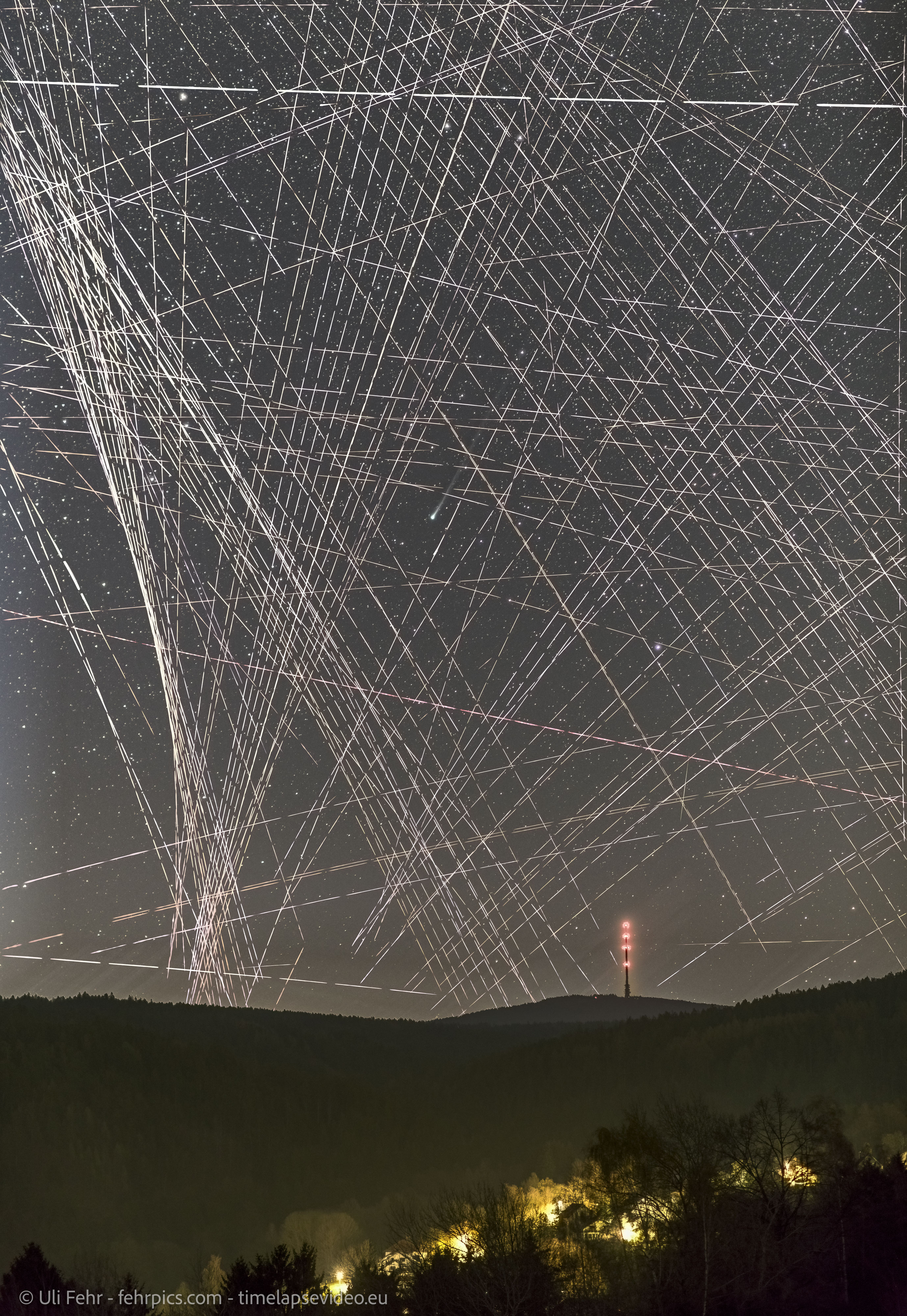
Comet R3 PanSTARRS Behind Satellite Trails

Customized Star Charts Coming 1st Quarter 2027
We respect your privacy. Unsubscribe at any time.
Hubble learns galactic history from stars
This NASA/ESA Hubble Space Telescope image provides a lesson in galactic history. The sparkling collection of stars is named Messier 30 (M30) after the French astronomer Charles Messier, who catalo…
ReadMake the most of long nights with this month’s new astronomy products
GS-100AR/AC High-Precision Guide Scope ToupTekHangzhou, China The GS-100AR/AC High-Precision Guide Scope is a guide scope, a wide-field imaging system, and a visual instrument. Its apochromatic des…
ReadHera mission gets its 1st closeup view of Didymos and Dimorphos
The Hera mission just got its 1st closeup view of Didymos and its little moonlet Dimorphos. Soon it will begin investigating the aftermath of the DART impact.
ReadNASA's Swift telescope has burned up, months after a robot sent to save it failed
NASA's Neil Gehrels Swift Observatory took its last look at the sky on Oct. 20, 2026, while orbiting about 171 miles (275 kilometers) above Earth. NASA ended the telescope's mission three days late…
ReadCuriosity captures a martian dawn
The morning Sun casts a hazy glow over Mars’ Mount Sharp, lighting up distant wind-carved rock formations known as yardangs. This scene is cropped from a six-image panorama captured by the Mastca…
ReadWebb Space Telescope's little red dots could hold key to first black holes
Johns Hopkins researchers searching the expanse of the universe for the existence of the first black holes are zeroing in on little red dots that may hold the key to the theoretical phenomenon.
ReadNov. 5, 2006: Mars Global Surveyor goes quiet
Designed to study Mars in a comprehensive way, examining its atmosphere, its interior, and its surface, the Mars Global Surveyor (MGS) launched Nov. 7, 1996. By Sept. 12, 1997, it would reach Mars …
ReadSwift spacecraft fell back to Earth in a fiery blaze yesterday
The Swift spacecraft fell back to Earth as a fiery streak of light yesterday. See videos here of the blazing reentry into Earth's atmosphere.
ReadESCAPADE mission to fly past Earth twice in 2 days
On November 7 and 9, 2026, the twin probes of the ESCAPADE mission — first Blue and then Gold — will perform flybys of Earth on the way to Mars.
Read