
The Rhythm of the Spheres
Reading the Night Sky
Wandering in Astronomy
The night sky is the oldest pattern of man, and every culture reads it differently. The stars above keep silent time, moving to a rhythm we are just now beginning to undertand. Astronomy is where math, science, art, music and words meet in a wonderous collision. On this section of our site, learn the basics, from how a star chart is actually made, to projections and art that map the night sky, to how astrolabe work the same as they did thousand years ago. Watch the North Star shift across centuries and explore how one sky has been mapped by many traditions. Check what happened on this day in space, or see tonight’s moon drawn for where you stand.
Map the Stars
The math behind star charts, with a projection explorer and a working astrolabe.
The Moving Sky
How the sky shifts across centuries, with a precession clock you can run.
The Traditions
One sky reads many ways, with a same-sky overlay of the world’s constellations.
This Day in the Stars
The sky’s events, discoveries, and lore tied to today’s date
The Moon Tonight
Its phase and face, drawn live for where you’re standing.
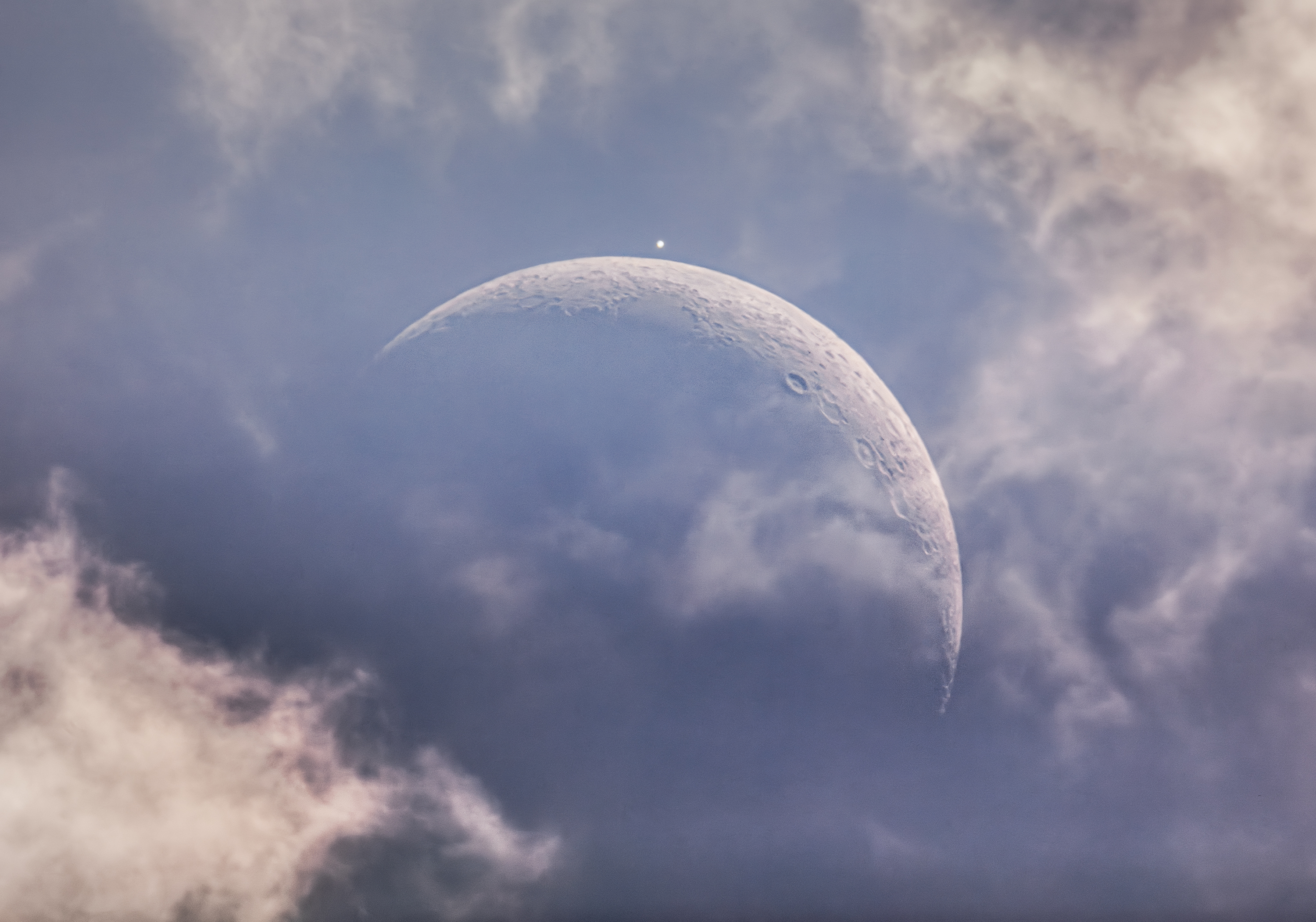
Daytime Moon Meets Evening Star

Customized Star Charts Coming 4th Quarter 2026
We respect your privacy. Unsubscribe at any time
June 20, 1955: Pingualuit Crater is discovered
On June 20, 1943, Pingualuit Crater (formerly known as Chubb Crater and as the New Quebec Crater) was first photographed by a U.S. Army Air Force crew during a meterological flight over northern Qu…
ReadSun news: Bam! M flare from a newcomer sunspot
Sun news for June 20, 2026: M1.3 flare from newcomer AR4472! A huge far-side prominence towers above the northeast. More action coming!
ReadVisible planets and night sky guide for June
EarthSky's visible planets and night sky guide. It's solstice weekend. Click in to learn what to watch for in your daytime and nighttime sky.
ReadThe Sky Today on Saturday, June 20: Libra’s Ghost Cluster
Looking for a sky event this week? Check out our full Sky This Week column. June 19: Dione crosses due north of Saturn Highest in the south around 10:30 P.M. local daylight time is the constell…
ReadNew JWST images of abnormally well-developed galaxy cluster open up the 'cosmic noon' frontier
A stunningly concentrated and hefty galaxy cluster, from a time in the universe's history when such massive structures aren't expected to have fully formed yet, is challenging cosmic evolution theo…
ReadBullet Cluster observations reopen dark matter debate with MOND-compatible explanation
The Bullet Cluster has so far been considered evidence of the existence of dark matter. An international team of researchers has now analyzed new data and current images from the James Webb Space T…
ReadJune 19, 2004: Astroid Apophis is discovered
On June 19, 2004, at the Kitt Peak National Observatory in Tucson, Arizona, astronomers Roy Tucker, David Tholen, and Fabrizio Bernardi discovered Asteroid Apophis. This Near-Earth Object (NEO), ap…
Read34 dust devils on Mars in 1 shot! Can you spot them all?
The Mars Express orbiter caught this view of the red planet, which is peppered with whirlwinds. Can you spot the 34 dust devils on Mars in this 1 shot?
ReadLong gamma-ray bursts may trace collapsing stars rather than neutron-star mergers
Long-duration gamma-ray bursts are some of the most energetic events in the universe, releasing more energy in just a few seconds than the sun emits in 10 billion years. Los Alamos National Laborat…
Read