

The Rhythm of the Spheres
Reading the Night Sky
Wandering in Astronomy
The night sky is the oldest pattern of man, and every culture reads it differently. The stars above keep silent time, moving to a rhythm we are just now beginning to understand. Astronomy is where math, science, art, music, and words meet in a wondrous collision. In this section of our site, learn the basics of astronomy: from how a star chart is made, to projections and art that map the night sky, to how an astrolabe works just like it did thousands of years ago. Watch the North Star shift across centuries, explore how one sky has been mapped by many traditions, read what happened on this day in space, and see tonight’s moon for your location.
Map the Stars
The math behind star charts, with a projection explorer and a working astrolabe.
The Moving Sky
How the sky shifts across centuries, with a precession clock you can run.
The Traditions
One sky reads many ways, with a same-sky overlay of the world’s constellations.
This Day in the Stars
The sky’s events, discoveries, and lore tied to today’s date.
The Moon Tonight
Its phase and face, drawn live for where you’re standing.
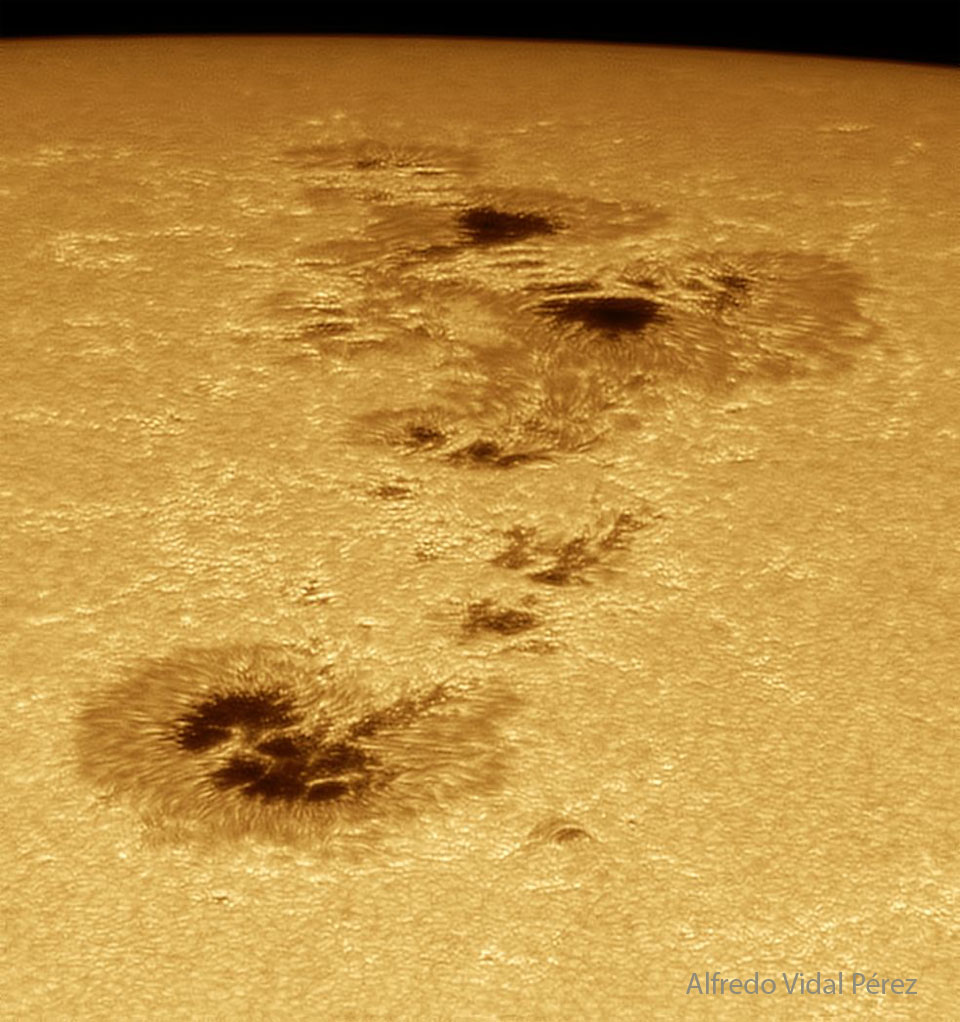
AR 4478: Giant Sunspot Group
Sky Surprise: What picture did APOD feature on your birthday? (after 1995)

Customized Star Charts Coming 1st Quarter 2027
We respect your privacy. Unsubscribe at any time.
The Sky Today on Wednesday, November 4: Venus and Spica stand close
Looking for a sky event this week? Check out our full Sky This Week column. November 3: The Moon passes Regulus Venus sits 2° south of Virgo’s brightest star, Spica, in the early…
ReadCrew emerges from Mars habitat simulation after yearlong test
On October 31, 2026, 4 participants in NASA's Mars habitat simulation emerged after 1 year of testing for what astronauts might encounter on a visit to Mars.
ReadJWST may have found where heavy black hole seeds formed
Astrophysicists think that the supermassive black holes (SMBH) we see in the modern universe are the result of a long, drawn-out process. That process is referred to as the hierarchical black hole …
ReadSailing through Cassiopeia
Andrea Arbizzi, taken from Maremma, Italy A vast sea of faintly lit dust in Cassiopeia envelops the Sailboat Cluster (NGC 225, upper right), an open cluster named for the way its brightest stars an…
Read2026 Full Moon calendar: When to see the Full Moon and phases
The phenomenon of a Full Moon arises when our planet, Earth, is precisely sandwiched between the Sun and the Moon. This alignment ensures the entire side of the Moon that faces us gleams under sunl…
ReadA tiny shift exposes a cold brown dwarf masquerading as an early galaxy
A faint red object spotted by the James Webb Space Telescope originally appeared to offer a possible glimpse of the universe's first galaxies. But images taken about 3½ years apart revealed a give…
ReadLeviathan's sprawling stars challenge idea that dusty giants become compact galaxies
Astronomers using the James Webb Space Telescope (JWST) have confirmed a massive, dust-rich galaxy called Leviathan in the early universe. Seen when the universe was roughly 1.5 billion years old, …
ReadSwift spacecraft fiery reentry expected within the next 24 hours
The Swift spacecraft is falling back to Earth. It will likely burn up in our atmosphere on November 4. Will you see it?
ReadWhen will the Blaze Star erupt? Will neutrinos give us a warning?
Astronomers are still waiting for the Blaze Star to erupt. New research suggests neutrinos could provide an early warning of its next outburst.
Read