Constellations Across Cultures – Six Ways to Map the Stars
Six ways of mapping the same sky: a cross-cultural tour

Orion as the naked eye sees it, with the principal stars labelled and the nebula visible below the belt
Till Credner, CC BY-SA 3.0, via Wikimedia Commons
Find the constellation Orion. Three stars in a short, straight row, together they form their famous belt and four bright stars at the corners setting the perceived figure from each culture around them. Every culture on Earth saw the same stars. The light leaving them is the same light. Yet, each gave a different explanation of the figure. The Greeks saw a hunter. Indian astronomers saw a deer. Chinese astronomers saw part of a great tiger. The Babylonians saw a shepherd. Egyptians saw a resurrected god. Astronomers in the Islamic world took the Greek figures but then added their own names.
The stars are the same, but the pictures groups traced in them are not. Six traditions, looking at one patch of sky, produced six different readings. To follow Orion’s story across cultures is a walk through history.
This page takes a region of sky and walks through how six traditions read it, then does the same, more briefly, for the area around the Pleiades.
Table of Contents
The traditions, in brief

Orion from Urania’s Mirror, the set of engraved star cards published in London in 1824
Sidney Hall, Public domain, via Wikimedia Commons
Six astronomical traditions anchor this tour. One of them, the Western, appears in two visual traditions, which is why a chart catalog often lists seven options rather than six.
Modern Western Descended from Greek and Ptolemaic astronomy by way of Arabic transmission and Renaissance refinement. Its 88 constellations were standardized by the International Astronomical Union in 1922, with the boundaries fixed soon after. This standard uses equatorial coordinates on the J2000.0 epoch and is the working language of professional astronomy worldwide.
Antique Western The same astronomical system, dressed in the visual conventions of the great printed star atlases: Bayer’s Uranometria of 1603, Hevelius’s Firmamentum Sobiescianum, Flamsteed’s Atlas Coelestis, Bode’s Uranographia. The constellation figures are rendered as engraved artwork, classical bodies drawn across the stars in early-modern European style.
Vedic The Indian tradition has been practiced continuously for roughly 3,000 years. It uses sidereal coordinates with one of several ayanamsas, the Lahiri being the standard, and is organized around the 27 nakshatras, divisions of the ecliptic tied to the Moon’s monthly journey rather than to the Sun.
Chinese An observational tradition with continuous records stretching back more than two and a half millennia. It uses equatorial coordinates and is built around 28 lunar mansions and three central enclosures, with the Four Symbols, one of them the White Tiger, laid like quadrants over the equatorial band.
Babylonian The Mesopotamian tradition ran from the second millennium BCE into the Hellenistic age. It gave the world the original zodiac and many of the figures the ancient Greeks used, and handled the motion of the Moon and planets with sophisticated arithmetic.
Egyptian A tradition with roots in the third millennium BCE, organized around the heliacal rising of Sopdet (Sirius) that announced the Nile flood, and around 36 decans used to tell time through the night. Its organization is distinct from the Mesopotamian one.
Persian and Arabic The astronomy of the Islamic golden age, roughly the eighth through fourteenth centuries, took Greek, Indian, and Persian work and integrated it. Figures such as al-Khwarizmi, al-Battani, al-Sufi, al-Biruni, and al-Tusi corrected the Greek positions, refined the astrolabe, and wrote many of the Arabic-derived star names still in daily use.
One patch of sky: the region of Orion
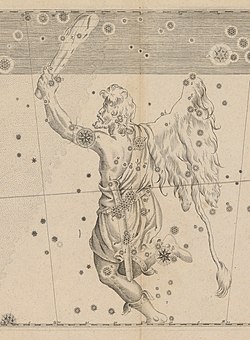
Orion from Johann Bayer’s Uranometria, the atlas that introduced Greek-letter designations for stars
Johann Bayer, Public domain, via Wikimedia Commons
The stars in play here are some of the most familiar in the heavens. In modern designations, they are Betelgeuse, the red supergiant; Rigel, the blue-white supergiant that is the brightest star in the group; Bellatrix; the three belt stars Mintaka, Alnilam, and Alnitak in a row; Saiph; and, hanging below the belt, the sword stars and the Orion Nebula.
Modern Western These stars form the constellation Orion, the hunter, a giant of Greek myth placed among the stars after his death. Betelgeuse and Bellatrix mark the shoulders, Rigel and Saiph the feet, and the three belt stars cinch the waist.
Antique Western The same stars and the same figure, but rendered with the artistry of the engraved atlases. Here, Orion wears a lion-skin and raises a club against the charge of Taurus or chases after the fleeing Pleiades. In a plate from Bayer’s Uranometria, the stars are pinned to specific points of an elaborately drawn classical body. The astronomy is identical to the modern version; the difference is one of visual culture, European and early-modern.
Vedic This region holds the nakshatra Mrigashira, the deer’s head, and Ardra, commonly identified with Betelgeuse. The image is not of a hunter but the hunted. It is imagined as the shape of a celestial deer, and part of the figure of the kalapurusha, the cosmic being. In the associated myth, the deer is pursued and shot, and in some tellings, the hunter is Sirius nearby. Mrigashira’s deity is Soma, the Moon, and Ardra’s is Rudra, the storm god. The nakshatra is associated with rain. The same stars that the Greeks read as a hunter, this tradition reads as the prey.
Chinese The region falls in the White Tiger, the symbol that rules the western quarter of the sky. Two lunar mansions sit here: Zi, the Turtle Beak, taking in the head of Orion, and Shen, whose name means Three Stars, named directly for the belt and gathering the bright corner stars around it. The figure is the tiger’s head and forelegs, the front of the great cosmic beast that guards the west. The Pleiades, the mansion called Mao, the Hairy Head, lie nearby in the same quadrant.

Orion as al-Jabbar in a 1125 Baghdad copy of al-Sufi’s Book of the Fixed Stars, now in the Museum of Islamic Art, Doha
Abd al-Rahman al-Sufi, Public domain, via Wikimedia Commons
Babylonian Here, the Mesopotamians saw the True Shepherd of Anu, a celestial herdsman, with the three-star belt at his waist. Because the Babylonian myth predates Greek ones by 250-350 years, it is possible that the Greek stories drew from Babylonian mythology. The hunter Orion may well be a cultural retelling of the Babylonian shepherd.
Egyptian To Egyptians, the stars were Sah and Sopdet. Sah was a striding figure identified with Osiris, with a three-star belt. To his southeast was the star Sirius, identified with the goddess Isis or Sopdet and cast as Sah’s wife. Their stars followed their myth: Osiris dies, is mourned, and rises again, just as Sirius vanishes and then returns at dawn to meet the life-giving Sun. Stars in this region also served as decans, markers that tell the hour.
Persian and Arabic This tradition took the Greek figures and renamed their stars in Arabic. These Arabic names are the ones we still use today. Betelgeuse comes from yad al-jawzā’, the hand of al-jawzā’; Rigel from rijl al-jawzā’ al-yusrā, her left foot. The belt stars carry Arabic words for a belt, a girdle, and a string of pearls: mintaqah, nitaq, nizam. The constellation as a whole was al-Jawzā’, a name that is grammatically feminine and built on a root meaning middle or central. Pre-Islamic Arabian sky lore may have had its own figure here, folded into the Greek Orion through translation. Al-Sufi’s tenth-century Book of the Fixed Stars listed the constellation with these Arabic names alongside the inherited Ptolemaic figure.
A second patch of sky: Taurus and the Pleiades
This diverse retelling elsewhere in the night sky. Take the area around the bull and the little cluster of stars riding on its shoulder. In modern Western readings, this is Taurus the bull, with the Pleiades as the seven sisters forever fleeing Orion across the sky. Antique atlases depict the same scene with the bull’s head lowered and charging.

The Saptarishi, the seven sages the Indian tradition sees in the stars of the Great Bear, in a Pahari folio of about 1700
Unknown artist, Public domain, via Wikimedia Commons
In the Vedic tradition, Rohini is the star Aldebaran, and Krittika forms the Pleiades themselves, a cluster tied to fire and to the war-god’s nursing mothers. Chinese astronomy names two mansions of the White Tiger in this stretch, Mao for the Pleiades, and Bi, the Net, for the V-shaped Hyades.
The Babylonians, once again the ancestors of much of this, called the bull the Bull of Heaven, almost certainly the original from which the Greek Taurus descends, and gave the Pleiades a name that simply meant the stars, the cluster so obvious it needed no embellishment.
Egyptian tradition put less weight on this region, though some decans fall here, and the Arabic tradition, inheriting the Greek bull, called the Pleiades al-Thurayya.
The Pleiades ride close enough to the Sun’s path that their first reappearance at dawn each year, their heliacal rising, fell at a useful point in the farming calendar, and culture after culture seized on it. Greek farmers timed sowing and harvest by them, Polynesian navigators and many other peoples built calendars around them, and the cluster’s annual return marked the turning of the seasons across much of the world. The stories differ, but a number of traditions independently used the same little knot of stars as a clock. The seven sisters, al-Thurayya, the Hairy Head; under every one of those names, the cluster did the same practical work.
Further reading
For readers who want to go deeper into cultural astronomy, three standard works are E.C. Krupp’s Beyond the Blue Horizon, Anthony Aveni’s Stairways to the Stars, and Clive Ruggles’s Ancient Astronomy: An Encyclopedia of Cosmologies and Myth, the last of which is a thorough reference for individual traditions.