
Dark Energy and the Cosmos we Call Home
DESI Dark Energy Map
When I was a teenager, I wanted to take an old satellite dish (one of the big ones) and turn it into a detector to map far off quasars. I was armed with my Edmund Scientific Red Ball telescope, and ready to go. Of course, that was also the summer I wanted to build a cloud chamber and a little teeny particle accelerator (all very possible experiments). None of these came to fruition, but the desire and potential of seeing the unseen is a desire that never left me.
That very same summer, my father made me a bat detector. He was a physicist and always tinkering around with electronic things so it was right up his alley. He took a microphone that was advertised as being sensitive in both the ultrasonic and the human audible wavelengths of sound, he then took the microphone’s output, filtered it to take out the audible, so all that was left was the ultrasonic. That trucated signal, went to an amplifier, and then I had my very own bat detector.
Well, with this microphone set, I could hear a world of the unseen around me. Magic. I could hear bats going overhead, and there was a world of screaming insects, hidden life, so much to hear that the normal ear could not hear.
The years have certainly passed, but that magic summer is one I won’t forget.
Thankfully, the world remains filled with things not yet explored, not yet seen, not yet defined.
Dark Energy Spectroscopic Instrument
DESI, short for Dark Energy Spectroscopic Instrument, is an international project managed by Berkeley Lab at Kitt Peak National Observatory in Arizona. There, on that high mountain, it and its 5,000 fiberoptic robot eyes have been silently mapping the large-scale structure of the universe to study dark energy for the last five years (though it is ahead of schedule).
It has succeeded beyond wildest expectations. Originally researchers hoped to gather information on 34 million galaxies and quasars, instead they mapped 47 million and will continue into 2028 gathering information on formations like dwarf galaxies and stellar streams.
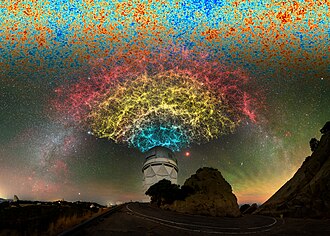
“This lovely universe we call home, a little speck going around a little star, in a small galaxy suspended in the enormous unknown.” -GoRhyme
Image from DESI Collaboration/KPNO/NOIRLab/NSF/AURA/P. Horálek/R. Proctor-An artistic rendering of a years worth of data.
The Amazing Findings
What did they find? What are researchers studying? The first goal of this study was to create a 3D map of dark energy and expand past studies. For this they used DESI a spectroscopic telescope made for studying far off objects, looking at their red shift and using them to make a map. It also uses baryon acoustic oscillations (BAO) to measure normal universe matter interspersed throughout the universe alongside dark energy.
A little confusing, I think of it like this. Say we have a giant container of infinite jello with a ready-to-explode “something” in the middle, only remember, the jello does not exist, it is just a model. That “something” sends out a pressure wave, like a sound wave, through the jello, and when the universe cools enough, that wave freezes in place.
For simplicity, just call those frozen wave positions differences in density. Since we know those, we can use them to measure our primordial plasma, the nothing jello. This is measured to be a 490 million light year length.
This is what the first phase of the study is looking at.
Next Directions
If this wasn’t amazing enough, the study will now continue to explore and gather data on dark energy and the nature of the very origins of the universe.
Preliminary data analysis suggests that the forces pushing our universe to expand, the dark energy itself, may not be fixed and constant, but still evolving. This challenges Einstein’s assumption that dark energy is a cosmological constant, unchanging and permanent. If it isn’t, everything we think we know about how the universe began, and where it is going, is back on the table.
Why is this in a blog about creativity? I think the answer is that it is a thing of unimaginable beauty, and the pictures are astounding.
The first images released show a universe of beauty. Here, previously unknown galaxies swirl in clouds of creation, fractal-like, which will come as no surprise to readers of this site.
We live in a world where we can wonder and create and look at the stars and try to understand it all. So, it is “Go Rhyme to the Rhythm of You” — this lovely universe we call home, a little speck going around a little star, in a small galaxy suspended in the enormous unknown, and we, little humans, can catalog it all and understand meaning.