
The Wandering Planets in the Night Sky
Look up tonight, and most of what you see is old. The constellations, the bright named stars, the patterns your eye learns to recognize, all of it looks essentially the same tonight as it looked to your grandparents, to people five hundred years ago, to people two thousand years ago. The night sky is, for human purposes, ancient and slow. But scattered among those fixed stars are five or six points of light that do not belong to the pattern. They move. Tonight they sit in one place; in three months they will have slid somewhere else; in a year they will be somewhere different again. These are the planets, part of the sky that makes any given night unique.
The ancient Greeks noticed this long before anyone understood why it happened. They called these objects planētes astéres, which means “wanderering stars.” They did not know about orbits or gravity. They simply saw that while the rest of the sky held its shape, a handful of bright lights drifted against that backdrop on their own schedule, and they named them for that behavior.
That wandering is the whole reason a star chart of a specific night means anything. Yes, the night sky is the constellations and the Moon, but the planets are what make a particular night that particular night. The fixed stars belong to a season. The planets belong to a date.
Table of Contents
How to pick a planet out of the sky

Planisphaerium Ptolemaicum (1660)
Andreas Cellarius, Harmonia Macrocosmica / Wikimedia Commons · Public domain
Where the planets are today
Five planets are easy to see with the naked eye under ordinary conditions: Mercury, Venus, Mars, Jupiter, and Saturn. Uranus sits right at the edge of what a sharp-eyed person can catch under a genuinely dark sky, and Neptune is beyond the naked eye entirely, requiring binoculars or a telescope. So in practice, when people talk about the visible planets, they mean those first five.
Telling a planet from a star is easier than it sounds once you know what to notice. Planets tend not to twinkle. A star is effectively a point of light, and the atmosphere jostles that point into the familiar shimmer; a planet shows a tiny disc that averages out the shimmer, so it shines with a steadier light. Planets are also usually brighter than the stars around them. Venus is the brightest object in the sky after the Sun and Moon, bright enough to be the “morning star” or “evening star” and occasionally bright enough to be mistaken for an aircraft. And planets keep to a narrow band: they stay on or near the ecliptic, the apparent path the Sun traces across the sky. If you can picture where that line runs, you know where to look.
Each planet has its own identity. Mercury is the hardest to see, always close to the Sun and only briefly visible low in the dawn or dusk. Venus is the easiest, dazzling, and brightest. Mars is visibly red. Jupiter is bright and steady, usually the second-brightest planet after Venus. Saturn is more modest, closer to a bright star, but you can place it by its spot on the ecliptic.
- Mercury0.348 AU5.9°
- Venus0.724 AU38.1°
- Earth0.993 AU35.2°
- Mars1.591 AU99.0°
- Jupiter5.314 AU133.4°
- Saturn9.426 AU11.8°
- Uranus19.431 AU63.0°
- Neptune29.877 AU2.8°
Heliocentric positions for 2026-10-29 at 00:00 TT, viewed from ecliptic north. Distance is from the Sun; the angle is ecliptic longitude measured from the March equinox. Orbits are drawn as true ellipses with the Sun at a focus. Each panel is linear in distance, so the two panels are not at the same scale. Elements from JPL (Standish), valid 1800–2050.
Why the planets cycle
Each planet returns to a given arrangement on its own clock, called its synodic period: the time between one alignment and the next, as seen from Earth. Mercury cycles in about 116 days, Venus in about 584 (close to a year and a half), Mars in about 780 (a bit over two years), Jupiter in about 399 days, and Saturn in about 378.

Planetary Orbits (1911)
Unknown engraver, Encyclopædia Britannica 11th ed., vol. 21, p. 715 / Wikimedia Commons · Public domain
The practical upshot is simple. A chart of April 14, 2003, and a chart of April 14, 2026, show the fixed stars in nearly the same arrangement, because the constellations barely change across a couple of decades. But the planets in those two charts sit in different places. Jupiter alone drifts about 30 degrees around the zodiac each year; Saturn moves about 12. Across years, those shifts add up to different skies. The planets are what keep a date from being interchangeable with the same date from another year. Our daily astronomy page includes star positions for this reason, so the day’s information holds true from year to year.
Retrograde motion

Motus Planetarum Superiorum (1742)
Johann Gabriel Doppelmayr, Atlas Coelestis / Bibliothèque nationale de France via Wikimedia Commons · Public domain
Now and then, a planet appears to stop, reverse course, and travel backward against the stars for a few weeks before resuming its normal direction. Earth has a faster, inner orbit, and as it sweeps past a slower outer planet like Mars, that planet seems to fall behind and slide backward, the same way a slower car beside you on the highway appears to drift rearward as you overtake it. Mars is the most dramatic version, tracing a backward loop of roughly 10 to 20 degrees over about two months. Mercury and Venus also appear to reverse near the point where they pass between Earth and the Sun, by the same perspective effect from the other direction.
Retrograde motion was a puzzle for ancient astronomers. Ptolemy put the planets on epicycles, small circles riding on larger ones. Copernicus’s Sun-centered model placed the Earth and planets correctly, orbiting around the Sun. However, since he made the orbits circular, he still used epicycles and eccentrics to make the calculations work. It was only when Kepler made the orbits elliptical that the movement made sense.
Conjunctions and oppositions
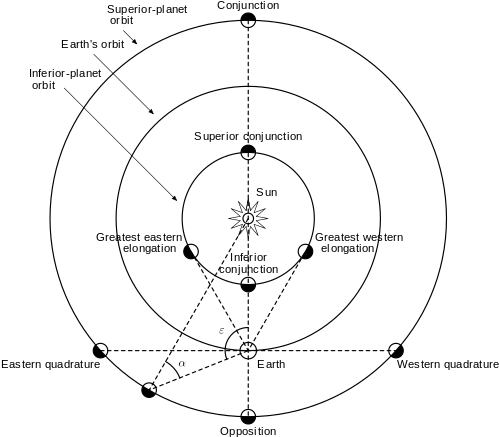
Planetary Configurations
Wmheric / Wikimedia Commons · CC BY-SA 3.0
Some dates land on a moment when the planets apparently converge. A conjunction occurs when two planets crowd into the same patch of sky; a close conjunction of two bright planets, such as Venus and Jupiter, puts two brilliant points side by side. An opposition is when an outer planet sits directly opposite the Sun, so it rises as the Sun sets, stays up all night, and sets at dawn. Opposition is the best time to see an outer planet, because it is both closest and lit full-face.
The grandest of these is the Great Conjunction, when Jupiter and Saturn meet, which happens only about once every twenty years. The one in December 2020 was the closest in centuries, the two planets drawing to less than a fifth of the Moon’s width apart, near enough to look almost like a single point. If a meaningful date happens to fall near an event like that, a chart of it carries a built-in highlight, a coincidence of the sky that was true on that night and no other.
The Moon, fastest of all
Nothing in the night sky moves like the Moon. It travels about 13 degrees a day, so much that its position shifts visibly from one hour to the next, and its phase changes from night to night through the familiar cycle: new, waxing crescent, first quarter, waxing gibbous, full, waning gibbous, last quarter, waning crescent, and back to new, the whole round taking about 29 and a half days. Because the Moon moves so fast and changes its face so steadily, its phase and position are among the most precisely identifying features any single night can have.
In antique charts, the Sun was a wandering planet too, one of the seven classical wanderers alongside the Moon, Mercury, Venus, Mars, Jupiter, and Saturn. Modern usage keeps “planet” for the bodies orbiting the Sun and files the Sun and Moon separately, but the Sun still matters enormously to any chart. For a moment in the day, its position is the whole story: was it above the horizon, and where?
Why this matters for what a chart means
For our lives, the stars are stationary, but in truth, the fixed stars are not truly fixed. They drift too, slowly, through their own motion across the sky, and over many thousands of years the constellations themselves deform. But across a single human lifetime, that change is too small to see, which is why, for the purpose of reading any given night, treating the stars as the steady backdrop and the planets as the wanderers is the right way to look up.

Zodiac Circle with Planets, NLW MS 735C (c. 1000)
Unknown scribe, f. 4v / National Library of Wales via Wikimedia Commons · CC0
A chart of the fixed stars alone is really a chart of a season. The constellations above you on January 14 are the same ones above you on January 11 or January 17; the general view does not change across a few days. What changes from night to night is the Moon’s position and phase, and, more slowly, the planets. So a chart that includes the wanderers and the Moon is a chart of a moment, while a chart that leaves them out is a chart of a time of year, wearing a specific date as a label.