The Pleiades Across Cultures: One Asterism, Many Skies
One of the nearest star clusters to Earth is the Pleiades. In Western astronomy, it is located within the constellation of Taurus. To us it looks like a little smudge of light, though it’s a cluster of 1000 stars, with about six or seven of them visible from Earth.
Almost every culture has noticed this cluster and woven stories around it. The Greeks and Aboriginal Australians saw seven sisters fleeing a hunter or a sorcerer, with one of them being lost. The Japanese saw a gathering, a coming-together, and Māori saw the eyes of a god and the turning of the year.
Table of Contents
What the Pleiades actually are

A labelled map of the Pleiades, naming the brightest members of the cluster
NASA, ESA and AURA/Caltech, Public domain, via Wikimedia Commons
The Pleiades, cataloged as M45, are an open star cluster in the constellation Taurus, sitting roughly 444 light-years away. (The distance has been argued over for decades; this is the figure most astronomers now agree on.) The cluster contains around a thousand stars, of which six to seven are visible to the naked eye, depending on your eyesight and how dark your sky is.
By star standards, the cluster is young, about 100 million years old. The brightest members are hot, blue-white and massive, the temperature signature of short-lived stars early in their lives. In long-exposure photographs, a soft haze surrounds the brightest stars. For a long time, people assumed this was leftover gas from the cluster’s birth, but it is actually a separate cloud of dust that the cluster is currently drifting through.
In modern catalogs the nine brightest members are named Alcyone, Atlas, Electra, Maia, Merope, Taygeta, Pleione, Celaeno, and Sterope. Sterope is also spelled Asterope, and it is a close pair, 21 and 22 Tauri, which some catalogs list as two stars. The list runs to nine rather than seven because Atlas and Pleione are the parents in the Greek myth, not sisters.
Greek and Mediterranean
In Greek myth traditions, the Pleiades are the seven daughters of the Titan Atlas and the sea-nymph Pleione: Alcyone, Maia, Electra, Taygeta, Sterope, Celaeno, and Merope. The story begins with the giant hunter Orion falling in love with them and chasing them relentlessly through the forest. The maidens run in fear for seven years until the god Zeus takes pity on them. He transforms them into doves, and places them into the sky as stars. Orion too goes with them, and so the eternal chase continues overhead, with the hunter forever following the sisters across the night sky, and never closing the gap. The constellation of Orion does, in fact, appear to trail the Pleiades as the sky wheels from east to west, so the story fits what is seen.
The Greeks also noticed that only six stars are easy to see. One version tells that Merope hid as she felt shame for marrying Sisyphus; another story is that Electra turned away in grief over the fall of Troy.
The cluster was practical as well as poetic. Around 700 BCE, the poet Hesiod used the rising and setting of the Pleiades to mark the seasons for plowing and harvest. This is one of the earliest written records of the cluster serving as an agricultural calendar. Greek sailors used it as a seasonal clock: the dawn rising of the Pleiades marked the opening of the safe sailing season, and the evening setting marked its close.
Vedic: Krittika
In Vedic astronomy, the Pleiades are Krittika, the third of the lunar mansions called nakshatras. The name conveys the sense of “the cutters” or “the razors,” and the cluster is tied to Agni, the god of fire, which gives the stars the nickname “fire stars.”
The mythology gives the Krittikas a maternal role. They are six women (sometimes seven) who became foster mothers to the war god Kartikeya, also known as Skanda or Murugan. In the story, Kartikeya is born with six heads so that he can nurse from all six Krittikas at once. There is also a pairing across the sky: in some traditions, the Krittikas are the wives of the seven sages, the Saptarshi, who are represented in the stars of Ursa Major. The two asterisms face each other, and the rising of Krittika marked an important point in the Vedic ritual calendar.
Chinese: Mao
In the Chinese system of 28 lunar mansions, the Pleiades are the mansion Mao (昴), often translated as “Hairy Head.” Mao belongs to the western quarter of the sky governed by the White Tiger, and the cluster represents the fur of the tiger.
Mao is one of the reference stars listed in the Yao Dian, an ancient text describing the stars that mark the seasons, suggesting the cluster has held its place in Chinese astronomy for a long time. Its bright, compact shape made it an easy landmark and an anchor for tracking positions across the sky.
Japanese: Subaru
The Japanese name Subaru, also written 昴, comes from a verb meaning to gather or to be united. What the name points to is not the individual stars but the fact of their togetherness, the cluster as a single bound thing.
We see the name surviving into the modern world. The Subaru car company takes its name and its six-star logo from the cluster; the merger of five companies with the parent company being the largest star. The cluster also has a long literary life in Japan. Sei Shōnagon listed Subaru among the beautiful things in her eleventh century book Pillow Book.
Māori and Polynesian: Matariki
In Māori tradition, the Pleiades are Matariki, the “eyes of the god” or “small eyes.” When Matariki rises at dawn in the depths of the southern winter, around June and July, it marks the Māori New Year. In 2022, New Zealand made Matariki an official public holiday.
The cluster runs through the wider Polynesian world under many names, Makaliʻi in Hawaiian among them. Polynesian wayfinders, navigating thousands of miles of open Pacific, used the cluster’s position as one of the markers that kept their canoes on course.
Australian Aboriginal traditions
Among the Aboriginal cultures of Australia, there are many distinct traditions about the Pleiades, and a recurring theme runs through them: seven sisters pursued by a man, often identified with the stars in Orion. The resemblance to the Greek story is striking. Historians don’t know if they share a common myth, or arrived at the same story separately.
The astrophysicist Ray Norris has argued that it might point to a shared origin reaching back tens of thousands of years, possibly before humans left Africa. That argument is speculative, and other researchers are unconvinced; it is best treated as an intriguing possibility rather than a settled fact.
The Seven Sisters Songline is one of the great narrative traditions of Aboriginal Australia, tracing the sisters’ journey across the continent in a way that links features of the land to features of the sky.
North and South American traditions
The cluster anchored calendars and ceremonies across indigenous cultures as well.
The Hopi of the American Southwest call the Pleiades Chuhukon, “those who cling together,” and the cluster’s rising and setting help time ceremonies, including Wuwuchim and Soyal. The Lakota call them Wicincala Sakowin, the Seven Little Girls, and for the Cherokee they are the seven boys who danced themselves up into the sky.
Farther south, the cluster was important for agriculture. The Inca called the Pleiades Qullqa, and saw the star cluster as a vast storehouse holding seed for spring planting. The Pleiades’ appearances in the sky organized their planting calendar. The Maya imagined the cluster as a rattlesnake’s rattle, and read its dawn return as a sign that the seasonal rain was coming and that it was time to plant maize.
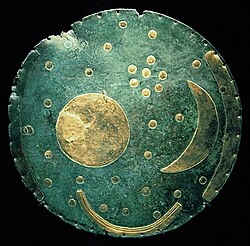
The Nebra sky disc, its gold inlays showing sun or full moon, crescent, scattered stars, and a cluster read as the Pleiades
Dbachmann, CC BY-SA 3.0, via Wikimedia Commons
The lost Pleiad
One thread that remains across these separate traditions: the sense that there should be seven stars, but only six are visible. Greek, Aboriginal Australian, Cherokee, and many other traditions tell of a lost sister or a missing star.
Why is there a story of a lost star? Astrophysicists Ray Norris and Barnaby Norris offer a possible explanation: that in the distant past, the cluster may have shown seven separate stars more clearly, and that the slow drift of Pleione toward neighboring Atlas has gradually blurred the two into one as the naked eye sees them. If that is right, the “lost” sister was once visible, and the stories preserve a memory of a sky that has since changed. The idea is debated, but the theory is interesting.
Why the Pleiades
So why this cluster, out of everything in the sky?
The Pleiades lie near the ecliptic, the path the Sun travels, making them visible from nearly all of Earth’s inhabited regions, and because the Sun passes near them in May and June, their dawn and dusk appearances fall at predictable points in the year, the kind of regularity a calendar needs.
Visually, the blue-white of their brightest members stands out against the warmer white of most bright stars, making the cluster easy to find and use as a marker for planting.