
The Rhythm of the Spheres
Reading the Night Sky
Wandering in Astronomy
The night sky is the oldest pattern of man, and every culture reads it differently. The stars above keep silent time, moving to a rhythm we are just now beginning to understand. Astronomy is where math, science, art, music, and words meet in a wondrous collision. In this section of our site, learn the basics of astronomy: from how a star chart is made, to projections and art that map the night sky, to how an astrolabe works just like it did thousands of years ago. Watch the North Star shift across centuries, explore how one sky has been mapped by many traditions, read what happened on this day in space, and see tonight’s moon for your location.
Map the Stars
The math behind star charts, with a projection explorer and a working astrolabe.
The Moving Sky
How the sky shifts across centuries, with a precession clock you can run.
The Traditions
One sky reads many ways, with a same-sky overlay of the world’s constellations.
This Day in the Stars
The sky’s events, discoveries, and lore tied to today’s date.
The Moon Tonight
Its phase and face, drawn live for where you’re standing.
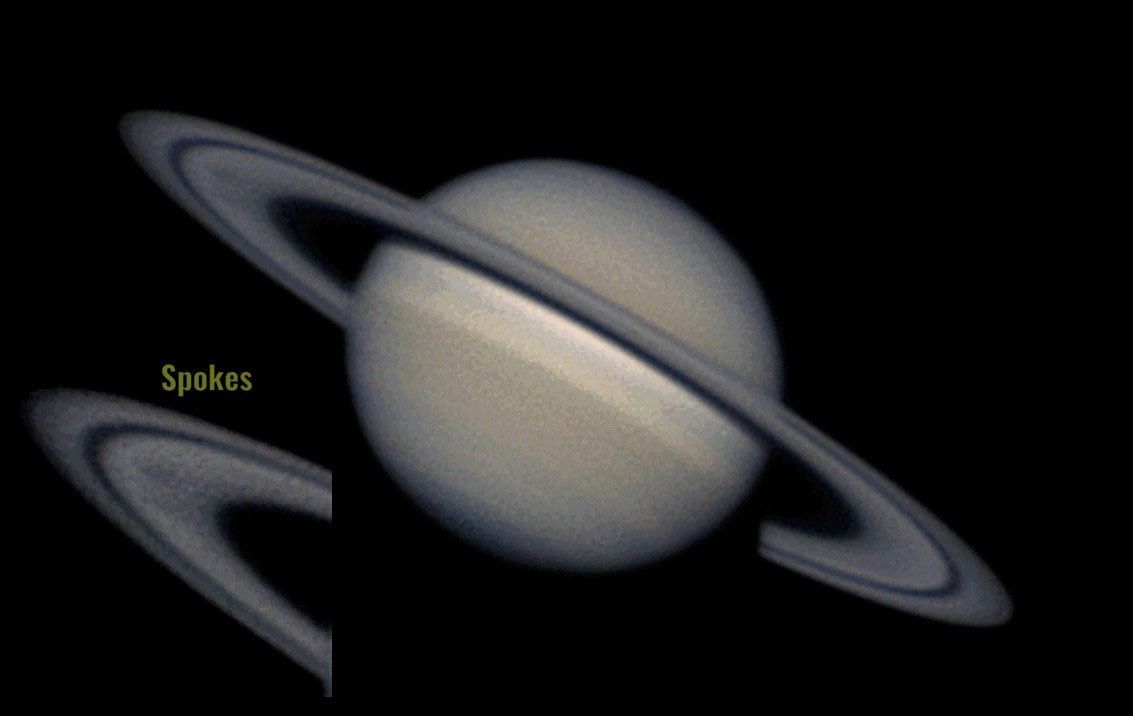
Spokes on Saturn's B Ring
Note: The text of this APOD has been revised.

Customized Star Charts Coming 1st Quarter 2027
We respect your privacy. Unsubscribe at any time.
South Korea eyes rocket debut and China lines up four launches
Rocket launches this week On Monday, Nov. 2, Rocket Lab launched The Sea God Surveys on an Electron rocket from its Launch Complex 1 on New Zealand’s Māhia Peninsula at 11:41 a.m. EST. Aboar…
ReadStars make oxygen for small galaxies, but they lose most of it
Scientists examining data collected by NASA's Hubble Space Telescope have found that dozens of small galaxies contain far less oxygen than their stars are estimated to have produced. The researcher…
Read2026 Full Moon calendar: When to see the Full Moon and phases
The phenomenon of a Full Moon arises when our planet, Earth, is precisely sandwiched between the Sun and the Moon. This alignment ensures the entire side of the Moon that faces us gleams under sunl…
ReadWhat is the physical size of a 1-billion-solar-mass black hole compared to the Sun?
When a supermassive black hole is measured as 1 billion solar masses, what would be its actual physical size relative to the size of our Sun? Joseph De BenedettoOxford, New Jersey The size of a bla…
ReadDust-shrouded Milky Way star cluster may be nearly as old as the universe
Astronomers have determined that VVV CL001, a metal-poor globular cluster near the center of the Milky Way, is about 13.4 billion years old, making it one of the oldest known star clusters in our g…
ReadVisible planets and night sky guide for November
Visible planets and night sky guide. Tomorrow morning, the moon will hang close to Mars, Jupiter and Regulus. And watch for Taurid meteors!
ReadSun news November 2: The word of the day is ‘plage’
Sun news November 2, 2026: Word of the day is plage! Learn to spot the sun’s bright magnetic patches, which glow long after sunspots fade away.
ReadSwift spacecraft fiery reentry will be in the next 2 days
The Swift spacecraft is falling back to Earth. It will likely burn up in our atmosphere on November 3 or 4. Will you see it?
ReadHeavy hydrogen in 3I/ATLAS's methane points to a frigid birthplace
The interstellar comet 3I/ATLAS carries a chemical clue to conditions in the planetary system of its origin, locked away long before it reached our sun. Its methane signature is unusually rich in h…
Read